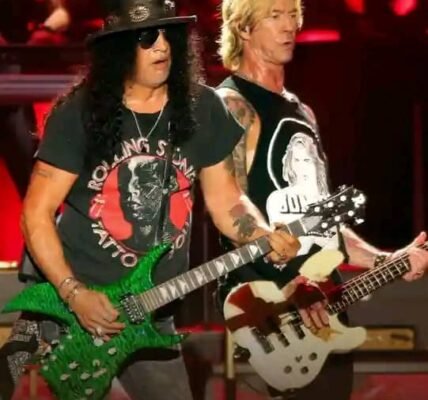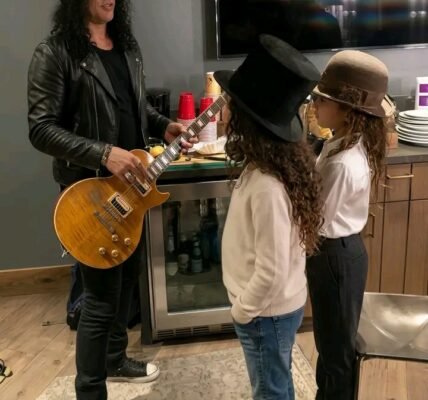
Slash’s son London Hudson chose drums partly because he did not want a guitar career measured against his famous father and explained his decision…

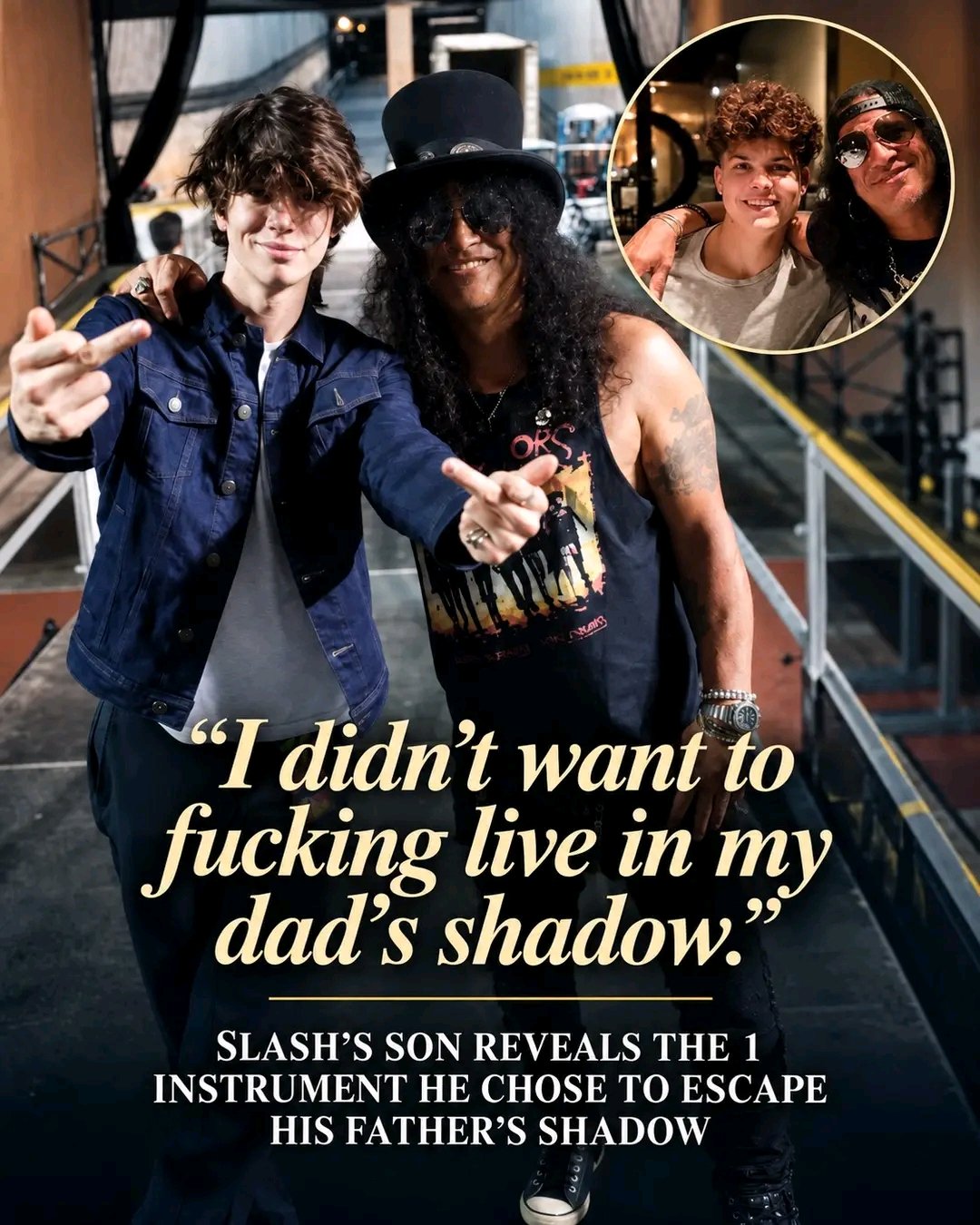
For most young musicians, having a legendary rock star as a father might seem like the ultimate advantage. For London Hudson, however, being the son of Guns N’ Roses guitar icon Slash came with a very different challenge: how do you build your own musical identity when one of the most recognizable guitarists in rock history is your dad?
The answer, surprisingly, was behind a drum kit.
London Hudson, Slash’s eldest son, has explained that although he can play some guitar, drums became his main passion partly because he did not want to spend his career being compared with his famous father. In interviews, Hudson was remarkably direct about the pressure that could come with choosing the same instrument as Slash.
“I do play a little guitar but drums is my main passion,” Hudson said in a 2020 interview with Consequence of Sound. He explained that he did not want to live in his father’s shadow and was interested in doing his own thing rather than attempting to compete with Slash.
That decision reveals something fascinating about growing up in a famous musical family.
Imagine picking up a guitar, writing a riff and immediately hearing someone say, “That sounds like Slash.”
Imagine playing a solo and having listeners compare your technique, tone and phrasing with the man behind some of rock’s most famous guitar work.
For London, avoiding that comparison was part of the appeal of becoming a drummer.
But there is an important detail that sometimes gets lost in the story.
London did not simply choose drums because he wanted to escape his father.
He genuinely loved the instrument.
His list of major drumming influences makes that especially clear.
Among the musicians Hudson has named as influences are Led Zeppelin legend John Bonham, Foo Fighters frontman and former Nirvana drummer Dave Grohl, progressive-rock powerhouse Jon Theodore and veteran hard-rock drummer Tommy Aldridge. He has also cited Animal from The Muppets as an influence, but the four human drummers reveal just how broad his musical interests are.
John Bonham represents the kind of larger-than-life rock drumming that helped define an entire generation.
The Led Zeppelin drummer was known for his enormous sound, powerful grooves and ability to make seemingly simple drum parts feel gigantic. For a young rock drummer, Bonham is almost unavoidable—and for Hudson, his influence connects directly to the classic hard-rock tradition surrounding his father.
Then there is Dave Grohl.
Grohl represents another side of rock drumming. His work with Nirvana helped define the explosive sound of alternative rock in the early 1990s, before he eventually became the frontman of Foo Fighters. Choosing Grohl as an influence suggests that Hudson was not limiting himself to the classic guitar-driven sound associated with Slash.
Jon Theodore adds another dimension.
Known for his technically demanding and highly expressive playing, Theodore has performed with groups including The Mars Volta and Queens of the Stone Age. His approach demonstrates how drums can become much more than a supporting instrument. The drummer can shape the atmosphere, tension and direction of an entire song.
And then there is Tommy Aldridge.
Aldridge is a veteran of hard rock and heavy metal whose career has included work with artists such as Ozzy Osbourne and Whitesnake. His powerful performance style fits naturally into the heavier side of Hudson’s musical influences.
Put those four names together and an interesting picture emerges.
London Hudson was not simply looking for an instrument that would make it easier to avoid Slash comparisons.
He was discovering an entirely different musical language.
Instead of trying to recreate the sound of one of rock’s most famous guitarists, Hudson could draw from Bonham’s power, Grohl’s aggression, Theodore’s complexity and Aldridge’s hard-rock attack.
That gives him room to develop a sound that belongs to him.
Hudson’s story also demonstrates the unusual pressure that can come with being the child of a rock legend. He grew up watching his father perform with Velvet Revolver and Guns N’ Roses, seeing enormous crowds and experiencing firsthand the scale of Slash’s fame. In an earlier interview, Hudson explained that seeing audiences react to his father eventually made him understand just how difficult it would be to separate himself from that legacy.
Yet Hudson never appeared interested in rejecting his father’s accomplishments.
Quite the opposite.
He has spoken respectfully about what his father and other legendary musicians achieved, while insisting that the younger generation should have the opportunity to create something of its own.
That distinction matters.
London Hudson was not saying Slash’s legacy was something he wanted to escape completely. He was saying he did not want that legacy to become his entire identity.
And perhaps that is why the drums became such a powerful choice.
On guitar, every note could potentially invite a comparison.
Behind the drum kit, Hudson could create his own vocabulary.
He could build from Bonham. He could borrow energy from Grohl. He could explore Theodore’s complexity. He could channel Aldridge’s heavy-rock power. Then he could combine those influences with his own experiences and instincts.
That is how musicians create identities.
Hudson’s journey has included projects such as Classless Act and Suspect208, the latter featuring other musicians who also came from famous rock families. He later continued developing his career with S8NT ELEKTRIC, demonstrating that his musical ambitions extend beyond simply being known as Slash’s son.
The irony is impossible to miss.
London Hudson entered rock music carrying one of the most recognizable surnames in the genre, but his most important musical statement may have been choosing an instrument other than his father’s.
Slash built his reputation with a guitar in his hands.
London chose the drums.
And rather than being defined by the shadow of a legendary guitarist, he appears determined to create a different path one beat at a time.
For fans expecting another Slash, that may be the wrong thing to look for.
The more interesting question is what London Hudson sounds like when he stops trying to be connected to his father and simply becomes himself.