
For decades, the image of Slash has been inseparable from the mythology of rock ’n’ roll: the towering black top hat, dark sunglasses, flowing curls, leather clothing, a cigarette between his fingers and the unmistakable Gibson Les Paul hanging from his shoulder.
As one of the most recognizable guitarists in rock history, the Guns N’ Roses legend has become almost larger than life. But long before he helped create some of the biggest guitar moments of the late 1980s and early 1990s, Slash was simply a creative kid growing up in an environment where music, fashion and visual art were part of everyday life.
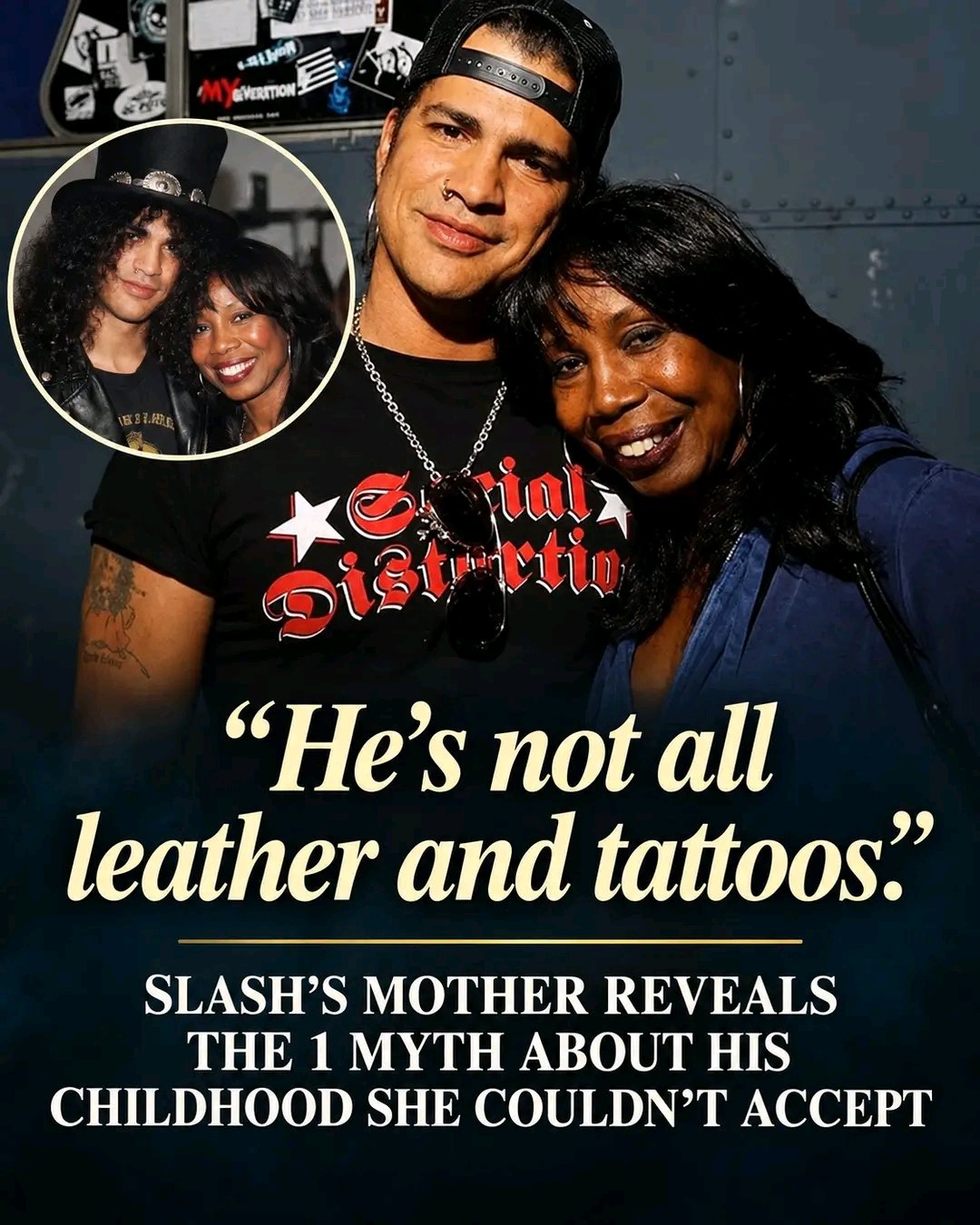
That earlier version of Slash is something his mother, Ola Hudson, remembered in a way that challenged the simplified rock-star mythology surrounding her son.
Ola Hudson was herself a remarkable creative force. Born in London, she became known as a fashion designer and costume designer, working with major artists and entertainers. Her professional world exposed Slash to creativity from an early age, giving him an upbringing that was very different from the stereotype sometimes attached to future rock stars.
Instead of seeing her son’s childhood only through the lens of rebellion, chaos and the eventual Guns N’ Roses lifestyle, Hudson remembered a boy whose artistic instincts appeared almost naturally.
One of the details that stands out from recollections of Slash’s childhood is his fascination with drawing. According to the memories associated with his mother, he had been drawing from a very young age—essentially from the time he could hold a pencil.
That detail matters because it reveals a side of Slash that can easily disappear beneath decades of rock mythology.
Today, fans primarily know him for his guitar playing. His name immediately brings to mind legendary riffs, extended solos and the sound of Guns N’ Roses. But creativity existed in his life before the guitar became his defining instrument.
The pencil came before the Les Paul.
The drawings came before the stage lights.
And the visual world surrounding his family helped shape the young person who would eventually become one of rock’s most recognizable figures.
Hudson’s career also meant Slash grew up around fashion and people working in creative industries. Her work brought her into contact with musicians, performers and artists, creating an environment where artistic expression was not something unusual.
That background offers another perspective on Slash’s development.
When fans look at photographs of him today, it can seem as though his image was always destined to become synonymous with rock rebellion. But his childhood was not simply a rehearsal for the leather-clad superstar he would eventually become.
There was an artistic foundation underneath it.
That distinction is important because rock history often compresses complicated lives into a handful of instantly recognizable images.
For Slash, those images are powerful. The top hat. The curls. The guitar. The sunglasses. The leather. The massive Guns N’ Roses concerts.
But they tell only part of the story.
His mother’s recollections bring attention to the creative identity that existed before those symbols became attached to his name.
And perhaps that is the part of his early life that the rock-star mythology has obscured the most.
Slash was not born with a top hat and guitar in his hands.
He was a child surrounded by creative influences.
His mother’s world of fashion and design provided a different kind of education, one based on imagination, visual presentation and artistic expression. Growing up around those elements could help explain why Slash’s eventual stage persona became so visually distinctive.
The guitarist’s image would later become inseparable from his music, but the connection between music and visual identity had already been present in his upbringing.
This is where the story becomes particularly fascinating.
The same person who would eventually become associated with loud amplifiers, distorted guitar tones and massive rock shows had first developed an interest in creating things on paper.
It is easy to overlook that when discussing a musician whose career has been dominated by guitar history.
Yet creativity does not always arrive in a single form.
Sometimes it starts with drawing.
Sometimes it develops through fashion.
Sometimes it emerges through music.
And sometimes those influences eventually combine into an identity that becomes impossible to separate from the artist.
Slash’s story appears to contain all of those elements.
By the time Guns N’ Roses exploded onto the international scene, however, the public saw a very different version of him. The band’s raw sound, rebellious attitude and chaotic reputation became central to their identity.
Slash’s appearance became iconic.
The guitarist became one of the faces of a generation of hard rock, and his personal history was increasingly viewed through that lens.
But his mother’s perspective provides an important reminder: there was a person behind the mythology long before the mythology existed.
There was a creative child before there was a rock icon.
There was an artist before there was a guitar legend.
And there was a young Slash growing up in a world where creativity was already surrounding him.
That perspective does not erase the complicated parts of his later life. Instead, it adds another layer to the story.
The rock star fans came to know did not appear out of nowhere.
He developed from a childhood filled with different forms of artistic influence, eventually finding the guitar and transforming those creative instincts into music.
That may be the greatest detail hidden beneath the familiar Slash legend.
Fans often remember the moment the world discovered Guns N’ Roses. They remember the albums, the concerts and the unforgettable guitar performances.
But long before millions of people knew his name, Slash was a boy drawing with a pencil.
And according to the recollections associated with his mother, that creative spirit was there from the beginning.
The leather and tattoos may have become part of the legend.
The top hat may have become an icon.
The guitar may have become his voice.
But underneath it all was something much older: an instinct to create.
That is the side of Slash’s childhood that the rock-star mythology can never fully capture and perhaps the side that makes his journey from creative child to global guitar legend even more fascinating.