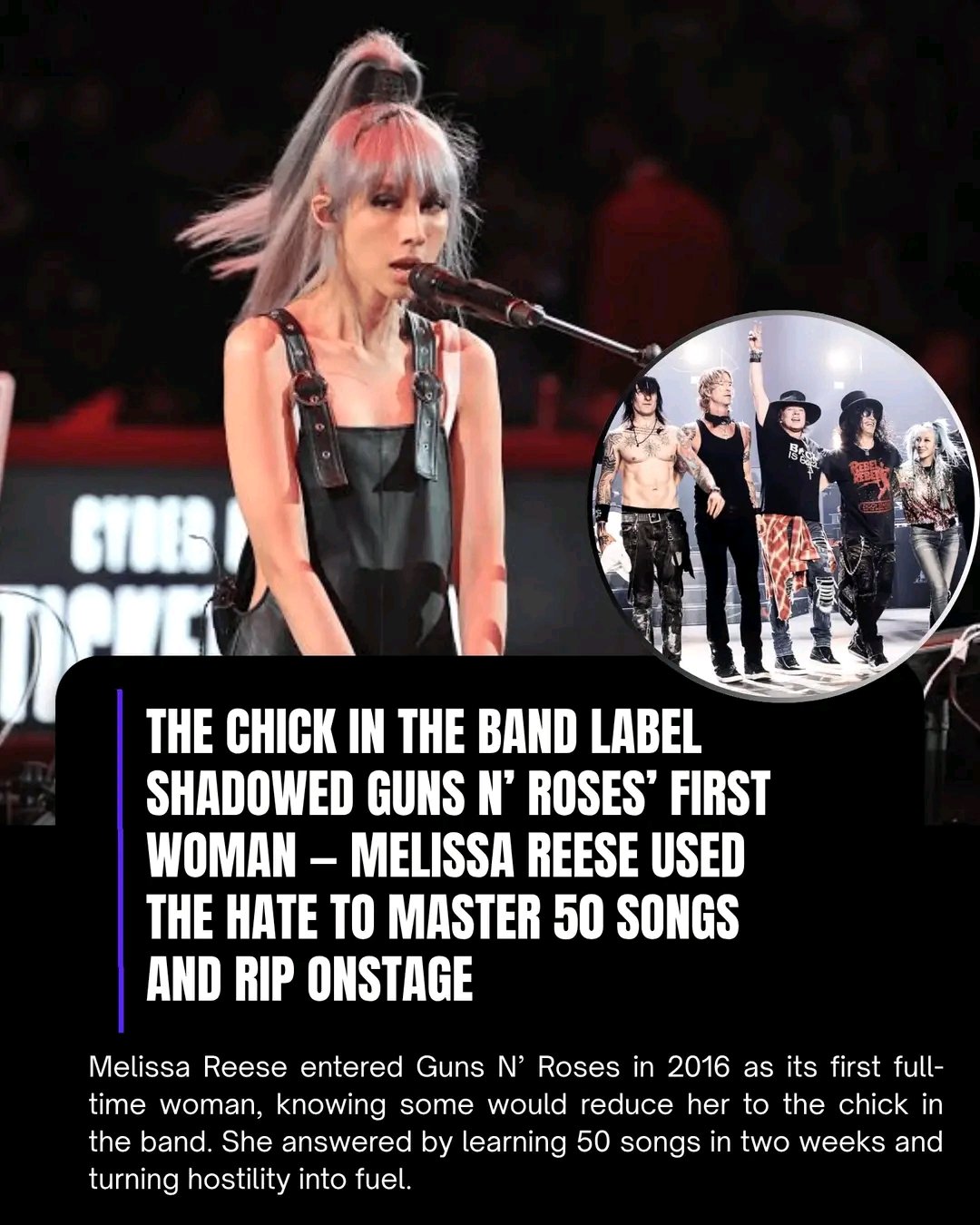
The Chick in the Band Label Shadowed Guns N’ Roses’ First Woman — Melissa Reese Used the Hate to Master 50 Songs and Rip Onstage. Melissa Reese storms into Guns N’ Roses as its first full-time woman, facing critics eager to dismiss her as the chick in the band. Given two weeks to master 50 songs, she turns exhausting rehearsals and every insult into creative fire, then unleashes it beneath the stadium lights. But the unexpected faces waiting afterward reveal that her fight reaches far beyond one legendary stage. See how the hate became her greatest weapon….

Joining one of the biggest rock bands in history is intimidating enough.
Doing it as the first full-time woman ever to perform with Guns N’ Roses? That comes with an entirely different level of pressure.
When Melissa Reese officially joined the legendary rock band in 2016 as keyboardist and backing vocalist for the massively successful Not in This Lifetime… Tour, she stepped into a spotlight unlike anything she had experienced before. Fans around the world celebrated the reunion of Axl Rose, Slash, and Duff McKagan, but Reese quickly found herself facing a different challenge proving she belonged.
For some critics, it wasn’t about her talent.
It wasn’t about her musicianship.
It wasn’t even about whether she could perform the songs.
To them, she was simply “the chick in the band.”
Melissa Reese had another idea.
Instead of arguing with critics, she decided to let her performances do the talking.
Two Weeks to Learn the Impossible
Few people appreciate just how enormous the challenge really was.
According to Reese, she had only about two weeks to prepare before rehearsals with one of the world’s biggest touring bands.
That meant learning approximately 50 songs spanning decades of Guns N’ Roses history.
Not only did she need to memorize keyboard parts, synthesizer programming, backing vocal arrangements, and technical transitions, but she also had to understand the rhythm of a live Guns N’ Roses concert a production known for marathon performances that often stretched well beyond three hours.
There was little room for mistakes.
Every rehearsal mattered.
Every note counted.
Entering a Legendary Family
Walking into rehearsals meant joining musicians who had created rock history.
Axl Rose.
Slash.
Duff McKagan.
Richard Fortus.
Frank Ferrer.
Dizzy Reed.
Each brought years of chemistry developed through countless concerts.
Melissa wasn’t replacing anyone’s legacy.
She was adding something new to it.
Rather than trying to change Guns N’ Roses, she focused on strengthening the band’s live sound by covering keyboards, synthesizers, electronic textures, percussion elements, and harmony vocals that helped recreate classic recordings on stage.
It required precision as much as creativity.
The Label That Wouldn’t Disappear
Despite her obvious qualifications, Reese noticed that many conversations centered less on her musicianship and more on her gender.
Articles frequently introduced her as “the first female member.”
Online comments sometimes reduced her to “the chick in the band.”
For some observers, her identity seemed more important than her talent.
It’s a label many women in rock have encountered over the years.
Instead of being recognized simply as musicians, they’re often asked to represent an entire gender.
That expectation creates pressure few male performers ever experience.
Melissa chose not to let those labels define her.
Turning Criticism Into Fuel
Rather than responding publicly to negative comments, Reese buried herself in preparation.
Hours became days.
Days became nights.
Programming equipment.
Learning arrangements.
Practicing transitions.
Perfecting harmony vocals.
Reviewing every possible scenario that could happen during a three-hour stadium performance.
By opening night, she wasn’t focused on critics anymore.
She was focused on delivering for the fans.
Under the Stadium Lights
When Guns N’ Roses launched the reunion tour, audiences immediately noticed Reese’s energy.
She wasn’t standing quietly behind a keyboard.
She attacked every performance with enthusiasm.
Whether triggering orchestral sounds, adding piano passages, layering synthesizers, or singing harmonies, she became an important part of the band’s modern live presentation.
The scale of the tour made every performance enormous.
Packed stadiums.
Massive festival crowds.
Millions of fans across multiple continents.
Night after night, Reese handled the demands with confidence.
Gradually, skepticism gave way to respect.
Winning Fans One Concert at a Time
Perhaps the biggest transformation happened after the shows.
Fans who had arrived unsure about the newest member often left impressed.
Many lined up hoping to meet Reese alongside the band’s longtime members.
Photos.
Autographs.
Conversations.
Stories.
Young girls especially approached her with excitement.
For many, seeing a woman performing alongside one of rock’s most legendary bands meant something deeply personal.
Representation matters.
Sometimes simply seeing someone who looks like you onstage changes what feels possible.
Reese has spoken about how meaningful those encounters became.
They reminded her that her role extended beyond keyboards and backing vocals.
She had become an inspiration to aspiring musicians who dreamed of playing rock music at the highest level.
Respect Earned the Hard Way
Within Guns N’ Roses itself, Reese earned praise for her professionalism and preparation.
Rather than expecting special treatment, she embraced the demanding workload that comes with performing in one of the world’s most celebrated live acts.
The band became known for lengthy sets that required tremendous stamina.
Every performance demanded concentration from beginning to end.
Reese consistently delivered.
That reliability became one of her greatest strengths.
Breaking Expectations
The rock world has historically been dominated by men, particularly within classic hard rock.
Melissa Reese’s presence challenged long-standing assumptions about who belongs on those stages.
Importantly, she didn’t ask audiences to lower expectations.
She met them.
Then exceeded them.
Instead of becoming “the female member,” she gradually became simply another essential part of the live band.
That distinction mattered.
It represented genuine acceptance based on ability rather than novelty.
More Than a Keyboard Player
Fans quickly discovered Reese contributed far more than keyboard parts.
Her electronic programming helped recreate complex studio arrangements.
Her harmony vocals enriched many classic songs.
Her versatility allowed Guns N’ Roses to perform material with greater sonic depth while preserving the spirit of the original recordings.
In modern arena rock, those contributions are invaluable.
The audience may not always notice every synthesizer layer or vocal harmony.
But they feel the difference.
The Power of Quiet Confidence
Melissa Reese never seemed interested in winning arguments online.
She didn’t spend interviews attacking critics.
She didn’t attempt to prove herself through headlines.
Instead, she relied on preparation, professionalism, and consistency.
Over time, those qualities spoke louder than any internet comment ever could.
The very label intended to diminish her eventually lost its power.
Fans increasingly discussed her performances rather than her gender.
That’s perhaps the strongest victory any musician can achieve.
A Legacy Still Growing
Today, Melissa Reese’s journey with Guns N’ Roses stands as a reminder that talent ultimately outlasts stereotypes.
Joining one of the world’s most iconic rock bands under intense public scrutiny would have overwhelmed many performers.
Instead, she embraced the challenge.
She learned an enormous catalog in a remarkably short time.
She performed before millions.
She earned the respect of fans and fellow musicians alike.
Most importantly, she demonstrated that rock music has always been about passion, dedication, and performance not outdated labels.
The critics who once dismissed her as “the chick in the band” underestimated one thing.
Melissa Reese never intended to fight them with words.
She fought with preparation.
She answered with music.
And night after night beneath stadium lights around the world, she proved that the strongest response to doubt is not an argument it’s an unforgettable performance.