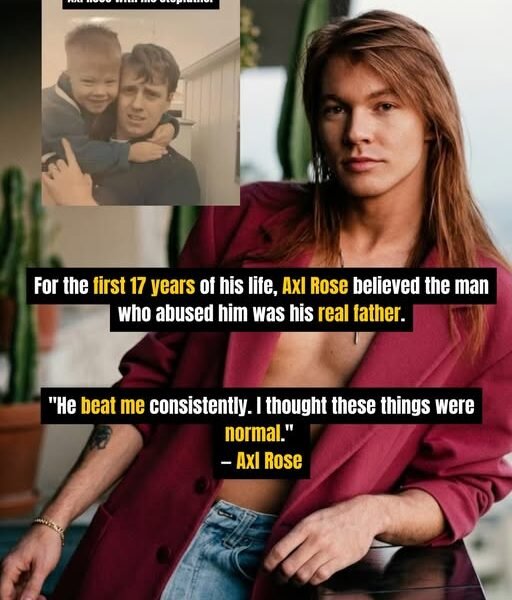
“HE BEAT ME CONSISTENTLY” The Dark Childhood Nightmare Axl Rose Says He Endured Before Becoming Rock’s Most Explosive Frontman…..

Before the sold-out stadiums.
Before the screaming fans.
Before Guns N’ Roses became one of the biggest rock bands on the planet.
There was fear.
There was anger.
And according to Axl Rose’s own account, there was a childhood so strict and frightening that it would leave emotional scars for years to come.
To millions of fans, Axl Rose is the untouchable rock icon whose voice helped define a generation. But behind the fame lies a story that sounds less like a rock-and-roll fairy tale and more like a psychological thriller.
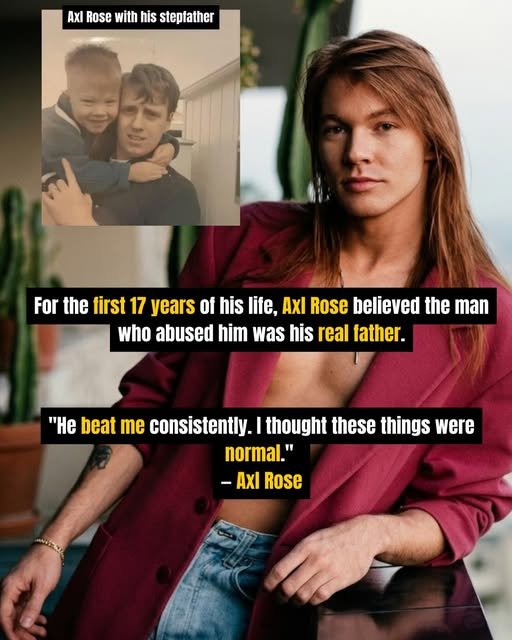
At the center of that story was Axl’s stepfather, Stephen L. Bailey, a man whom Axl later described as an imposing religious authority figure whose strict rules dominated every aspect of family life.
And if Axl’s recollections are accurate, the reality behind closed doors was far darker than anyone could have imagined.
A House Ruled by Fear
Growing up in Indiana, Axl’s world was tightly controlled.
According to his accounts, television was forbidden.
Movies were forbidden.
Popular music was forbidden.
The outside world itself was often portrayed as dangerous, corrupt, and sinful.
Only church-approved influences were allowed.
For a child with curiosity, imagination, and a rebellious spirit waiting to emerge, it was like living inside a cage.
While other kids watched television and listened to the latest songs, Axl’s life revolved around church activities and religious expectations.
By the age of five, he was already singing in church.
But according to Axl, this wasn’t necessarily the result of personal passion.
It was simply expected.
Submission to church life wasn’t optional.
It was mandatory.
The Shocking Claims
Years later, Axl spoke openly about his childhood in interviews, including one of his most discussed conversations with Rolling Stone.
His words stunned fans.
“He beat me consistently. I thought these things were normal.”
Those seven words painted a chilling picture.
According to Axl, physical punishment wasn’t rare.
It was routine.
He described growing up believing that such treatment was simply part of life because it was all he had ever known.
The normalization of violence, he suggested, became one of the most disturbing aspects of his childhood.
Only later did he begin realizing that what he experienced wasn’t normal at all.
The Secret That Changed Everything
Perhaps the most shocking revelation came when Axl discovered the truth about his identity.
For years, he believed Stephen Bailey was his biological father.
That was the story he had been told.
That was the reality he accepted.
Then everything changed.
As a teenager, Axl learned that Bailey was actually his stepfather.
Even more astonishing, he discovered that his real surname wasn’t Bailey.
It was Rose.
The name that would later become famous around the world had been hidden from him.
The revelation shattered the version of reality he had lived with for most of his life.
Suddenly, questions emerged.
Why had the truth been concealed?
Why hadn’t he been told earlier?
And what else about his life wasn’t what it seemed?
The discovery reportedly had a profound impact on him.
Religion, Guilt, and Rebellion
According to Axl’s recollections, religion played a central role in the household.
But rather than providing comfort, he often described it as a source of fear and guilt.
He recalled being told that ordinary teenage interests could lead to damnation.
Wanting to hear popular music.
Wanting to explore the outside world.
Wanting the same experiences as other young people.
These weren’t viewed as harmless curiosities.
According to Axl, they were treated as moral dangers.
Yet the harder restrictions were enforced, the stronger his rebellious streak became.
What began as curiosity gradually transformed into resistance.
And resistance eventually became rebellion.
Rock Music Became an Escape Route
For Axl, discovering rock music was more than entertainment.
It was liberation.
Bands like Led Zeppelin and Aerosmith offered a glimpse into a completely different world.
A world filled with freedom.
A world filled with self-expression.
A world that stood in direct contrast to the restrictions he says he experienced growing up.
His long hair became an act of defiance.
His attitude became an act of defiance.
Even his musical ambitions became an act of defiance.
Each step moved him further away from the environment he believed had controlled him for so long.
The Escape That Changed Rock History
By age 17, the walls were closing in.
The truth about his biological father had emerged.
His relationship with authority had deteriorated.
And his desire for freedom had become impossible to suppress.
Eventually, he left Indiana behind.
He headed to Los Angeles.
At the time, few could have predicted what would happen next.
The angry teenager searching for a new life would eventually become Axl Rose.
The frontman of Guns N’ Roses.
One of the most recognizable figures in rock history.
Turning Pain Into Power
What makes Axl’s story so compelling is that it isn’t simply about fame.
It’s about transformation.
The same stubbornness that reportedly caused conflict during his youth became one of his greatest strengths.
The same refusal to submit helped fuel his artistic identity.
The same determination to escape helped launch one of rock’s most extraordinary careers.
Whether on stage screaming through “Welcome to the Jungle” or commanding stadium crowds decades later, Axl Rose carried the intensity of those early experiences with him.
And perhaps that’s why his story continues to fascinate fans.
Because behind the legendary singer stands a young boy who, according to his own account, spent years fighting for freedom long before he ever stepped onto a stage.
The journey from that restrictive Indiana household to worldwide superstardom wasn’t just unlikely.
It was almost unimaginable.
Yet somehow, Axl Rose made it happen.
And in doing so, he turned one of rock’s darkest childhood stories into one of its greatest comeback tales.