

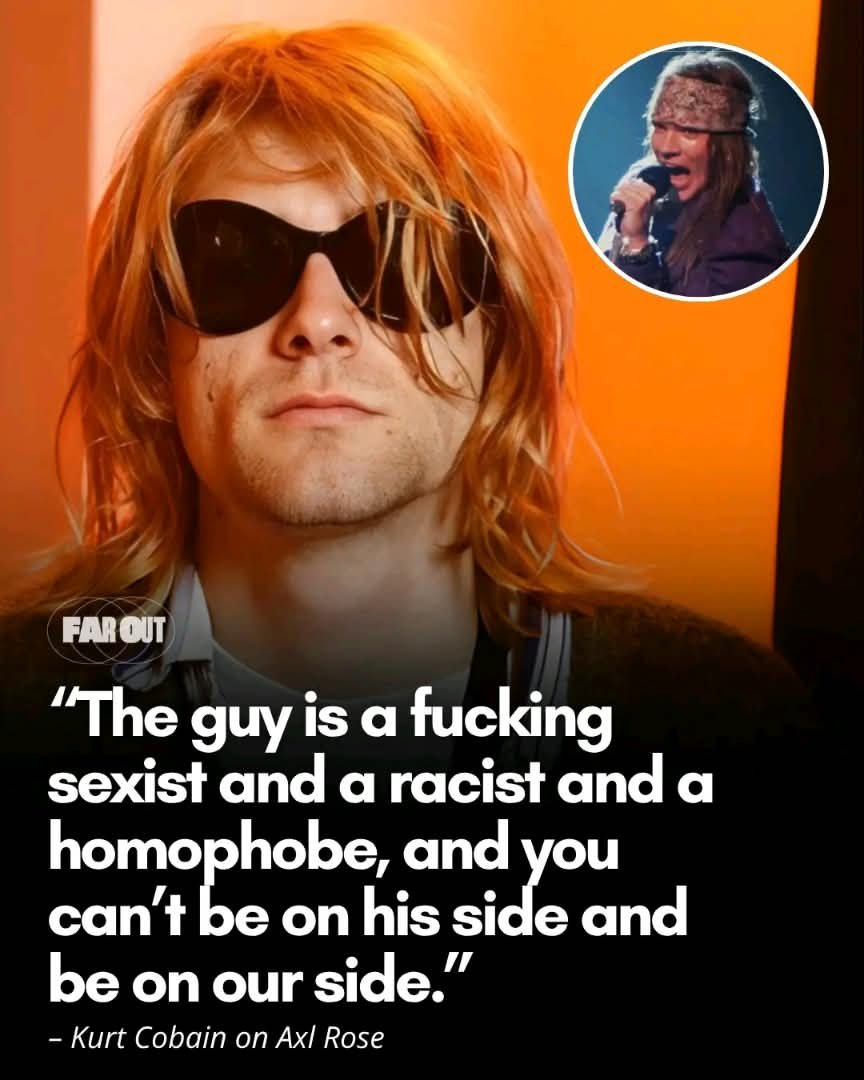
Kurt Cobain was never afraid to speak his mind.
As the frontman of Nirvana, he became one of the defining figures of the alternative-rock explosion of the early 1990s. But while millions of fans worshipped the biggest names in rock, Cobain often had a very different opinion of the music surrounding him.
He could be brutally dismissive. He questioned rock-star culture, mocked musical clichés and frequently made it clear that certain bands represented everything he disliked about mainstream rock.
That makes Cobain’s list of musical enemies particularly fascinating.
From Guns N’ Roses’ larger-than-life hard-rock spectacle to the arena dominance of AC/DC, here are five bands that famously found themselves on the wrong side of Kurt Cobain’s musical taste.
Guns N’ Roses
Few rock rivalries of the early ’90s generated as much curiosity as the tension between Nirvana and Guns N’ Roses.
At first glance, the two groups seemed almost destined to clash. Guns N’ Roses represented the enormous, swaggering hard-rock machine: leather, stadiums, guitar solos, excess and larger-than-life personalities.
Nirvana represented something radically different.
Cobain’s songwriting was rooted in punk, underground rock and emotional vulnerability. He often resisted the idea of becoming a traditional rock star, even as Nirvana became one of the biggest bands on the planet.
Guns N’ Roses, meanwhile, had embraced the very rock-star mythology that Cobain seemed determined to dismantle.
The relationship became particularly tense around the time both bands occupied the same cultural space. Cobain was openly critical of the group, while Axl Rose had his own harsh opinions about Nirvana.
The hostility became impossible to ignore.
For Cobain, Guns N’ Roses could symbolize the kind of rock establishment he wanted to challenge. For fans, however, the feud became one of the most fascinating clashes between two radically different visions of rock.
It wasn’t simply about music.
It was about what a rock band was supposed to be.
AC/DC
AC/DC might seem like an unusual target for someone who loved loud guitars and distorted rock.
After all, Nirvana’s music could be thunderous.
But Cobain’s musical philosophy wasn’t simply about volume. He often cared deeply about authenticity, attitude and whether music felt genuine rather than manufactured for mass consumption.
AC/DC had spent decades perfecting a very specific brand of hard rock—powerful riffs, huge choruses and unmistakable stage theatrics.
While countless musicians admired the Australian legends, Cobain’s relationship with that kind of traditional rock could be far more complicated.
He came from the punk tradition, where simplicity and rebellion often mattered more than technical virtuosity or arena spectacle.
That difference is important.
Cobain wasn’t necessarily rejecting every loud guitar riff. He was rejecting the culture surrounding the type of rock he felt had become predictable.
And AC/DC stood firmly among the giants of that traditional hard-rock world.
Poison
If there was one musical movement that Nirvana helped push out of the spotlight, it was the glam-metal explosion of the 1980s.
Poison were one of its most recognizable names.
With outrageous hairstyles, colorful clothing, power ballads and party-rock anthems, Poison represented almost the complete opposite of Nirvana’s underground aesthetic.
Cobain’s image was deliberately anti-glamour.
He wore thrift-store clothing. He embraced imperfections. He frequently challenged expectations about masculinity and rock-star presentation.
Poison, by contrast, had turned appearance into part of the performance.
Their music was designed for huge stages, MTV exposure and sing-along audiences.
For Cobain, that world could represent the commercial excess he wanted to escape.
The irony, of course, is that Nirvana eventually became massively successful themselves.
Cobain found himself trapped inside the same celebrity machine he had spent years criticizing.
That contradiction became one of the central tensions of his career.
Mötley Crüe
Mötley Crüe were another defining symbol of the hair-metal era that Cobain’s generation helped overthrow.
The Los Angeles band became famous for outrageous lifestyles, massive concerts, controversial behavior and a hard-partying image that became almost inseparable from their music.
Nirvana’s arrival changed the conversation.
Suddenly, audiences were hearing songs that sounded rawer, darker and less polished. The carefully constructed image of the traditional rock star began to look increasingly outdated.
Cobain became one of the faces of that cultural shift.
His frustration with bands such as Mötley Crüe wasn’t necessarily based on whether their musicians could play. Instead, it was connected to what their entire rock mythology represented.
For Cobain, rock music wasn’t supposed to be about expensive clothes, celebrity excess and carefully manufactured rebellion.
It was supposed to feel dangerous because it was honest.
That philosophy helped make Nirvana revolutionary.
Winger
Then there was Winger.
The band’s name became almost synonymous with the kind of polished late-1980s rock that Nirvana’s generation would later mock.
Winger had musicianship, melodic songwriting and a polished image. But that was precisely the problem for Cobain’s musical worldview.
The band’s clean-cut presentation became an easy target for the emerging alternative-rock culture.
One of the most famous examples came through the cultural impact of the television show Beavis and Butt-Head, where Winger became a recurring object of ridicule.
Cobain’s generation had developed an appetite for tearing down the symbols of the previous decade.
Winger became one of those symbols.
Yet history has a funny way of changing perceptions.
Many musicians who were dismissed during the grunge explosion have since received renewed appreciation for their technical abilities and songwriting.
That doesn’t necessarily change Cobain’s attitude but it does remind us that musical taste is never permanent.
The Bigger Picture
Kurt Cobain’s dislike of certain bands wasn’t simply a list of personal grudges.
It reflected a much larger cultural battle.
Nirvana emerged at a moment when rock music was changing dramatically. The polished spectacle of the 1980s was giving way to something rawer, stranger and more emotionally exposed.
Cobain became one of the most recognizable faces of that revolution.
But there was an uncomfortable irony.
The man who disliked rock-star excess became one of the biggest rock stars in the world.
The musician who distrusted fame became a global celebrity.
And the artist who wanted to escape the commercial machinery of music became the frontman of a band whose albums sold millions.
That contradiction is part of what continues to make Cobain so fascinating.
Whether fans agree with his opinions or not, his musical judgments helped define an era.
And decades later, the names he criticized still provoke debate.
Because when Kurt Cobain spoke about rock music, people listened even when he was telling them exactly what he couldn’t stand.