
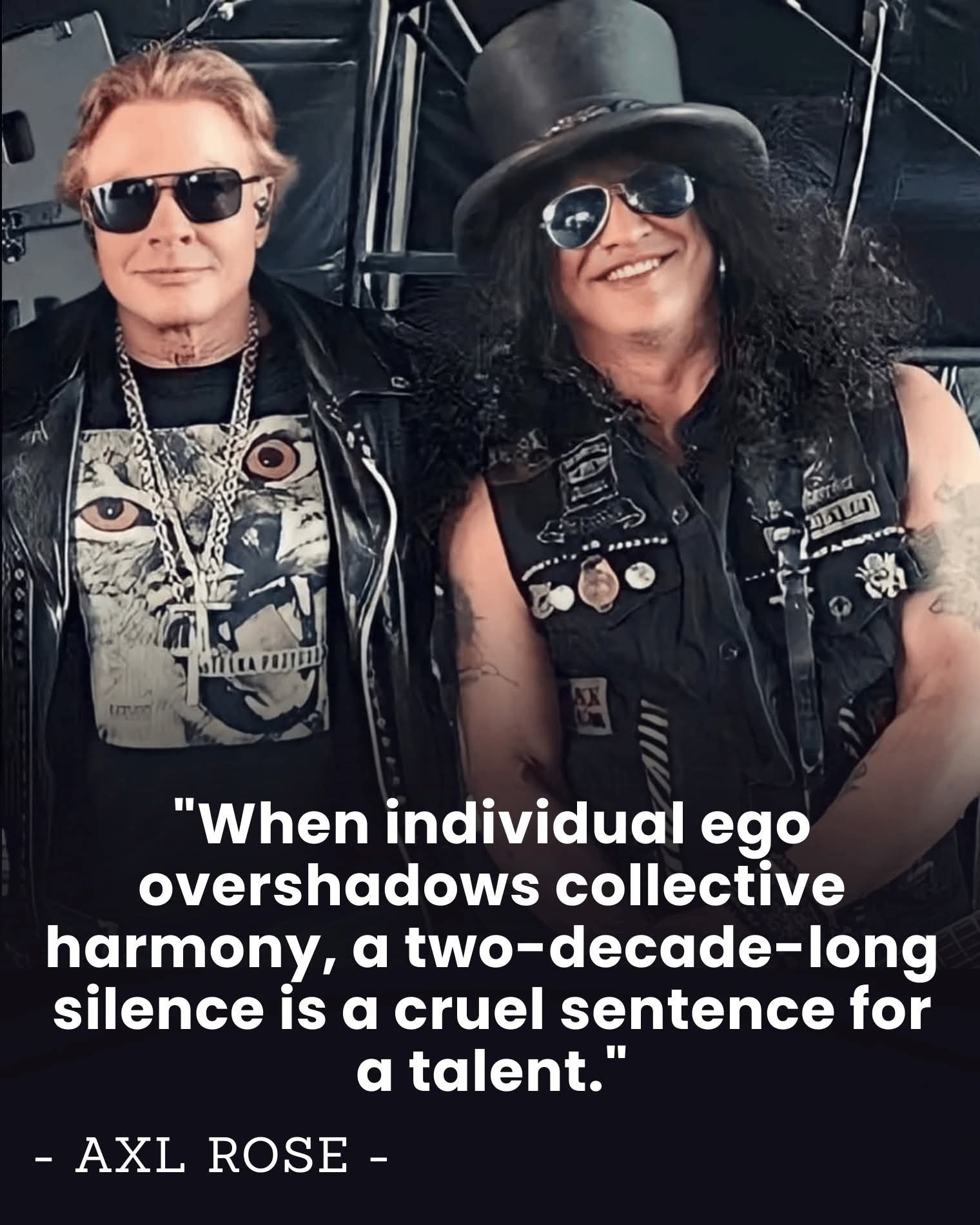
By refusing to bend by choosing absolute authority over collaboration Axl Rose didn’t just fracture Guns N’ Roses. He effectively erased nearly two decades of what could have been one of the greatest creative runs in rock history. The reunion made millions. Stadiums sold out. Nostalgia roared back to life.
But the masterpieces that were never written?
Those are gone forever.
In the late ’80s and early ’90s, Guns N’ Roses weren’t just a band. They were a volatile force of nature. Appetite for Destruction wasn’t simply successful it was seismic. A raw, dangerous cocktail of street-level menace and musical brilliance, powered by the combustible chemistry between Axl Rose, Slash, Duff McKagan, Izzy Stradlin, and Steven Adler.
That chemistry was fragile. And Axl knew it.
As the band’s fame exploded, so did Axl’s need for control. Creative disagreements became ultimatums. Rehearsals turned into battlegrounds. Contracts were rewritten. Loyalty was tested. One by one, the cracks widened.
By the mid-1990s, the unthinkable happened: Guns N’ Roses became a band in name only.
Slash walked. Izzy was already gone. Duff followed. What remained was Axl Rose isolated, guarded, and convinced that compromise meant weakness. He kept the name. He kept the power. But the magic? That slipped quietly out the back door.
Fans waited. And waited.
Years passed. Then decades.
Albums were promised, teased, delayed. Legends grew around the mythical Chinese Democracy, an album that became shorthand for artistic paralysis. When it finally arrived in 2008 after years of rewrites, lineup changes, and reported costs exceeding $13 million it wasn’t a failure.
But it wasn’t Guns N’ Roses.
It was meticulous. Polished. Lonely.
The fire born from five clashing personalities was gone, replaced by one man’s vision—brilliant in moments, but missing the chaos that once made the band untouchable. What listeners heard wasn’t just a different sound. It was the sound of isolation.
And that isolation cost rock music dearly.
Imagine an alternate timeline: Guns N’ Roses evolving through the ’90s, colliding with grunge, adapting to alternative rock, aging like the Rolling Stones or Aerosmith. Albums shaped by maturity instead of resentment. Songs born from brotherhood instead of bitterness.
None of that happened.
Because control won.
Axl Rose held the line so tightly that nothing else could breathe. In protecting his vision, he unknowingly strangled it. The golden age those years where tension fuels genius expired in silence.
By the time the impossible reunion finally happened in 2016, the damage was already done.
Yes, Not In This Lifetime… became one of the highest-grossing tours in history. Yes, seeing Axl, Slash, and Duff on stage together again sent shockwaves through rock culture. Fans cried. History healed it least on the surface.
But money can’t buy back time.
The reunion didn’t produce a new Appetite. It didn’t unleash a late-career masterpiece. It didn’t resurrect the albums that should have existed between 1993 and 2016. What it delivered was celebration, not creation.
And that’s the quiet tragedy at the heart of the Guns N’ Roses story.
For nearly 20 years, one of the most dangerous, gifted bands on Earth was effectively muted not by drugs, not by death, not by irrelevance but by stubborn pride. Ego replaced trust. ontrol replaced collaboration.
Axl Rose didn’t lose his band overnight. He lost it slowly, decision by decision, compromise by compromise until there was nothing left to compromise with.
To be fair, Axl paid a personal price too.
Behind the fortress of control was a man growing lonelier by the year. Former bandmates became ghosts. Old friendships turned into lawsuits and silence. The world mocked delays, speculated endlessly, and reduced a once-feared frontman into a punchline.
Power without connection is hollow. And Axl felt that.
When the reunion finally came, it wasn’t just business it was relief. Proof that even the most rigid walls can crack. But cracks don’t rebuild lost decades.
What Guns N’ Roses regained in unity, they could never recover in creative time.
Rock history is filled with bands destroyed by excess. Guns N’ Roses stands apart as a band paused by control. Their silence wasn’t accidental it was enforced. And the cost wasn’t just commercial or cultural.
It was artistic.
Today, the legend remains untouchable. The songs still roar. The crowds still scream. But somewhere between Use Your Illusion and the reunion tour lies a graveyard of unwritten riffs, unrecorded albums, and unfulfilled potential.
That’s the price Axl Rose paid for control.
Not failure.
Not obscurity.
But something far more haunting:
A legacy forever shadowed by what might have been.
Leave a Reply