
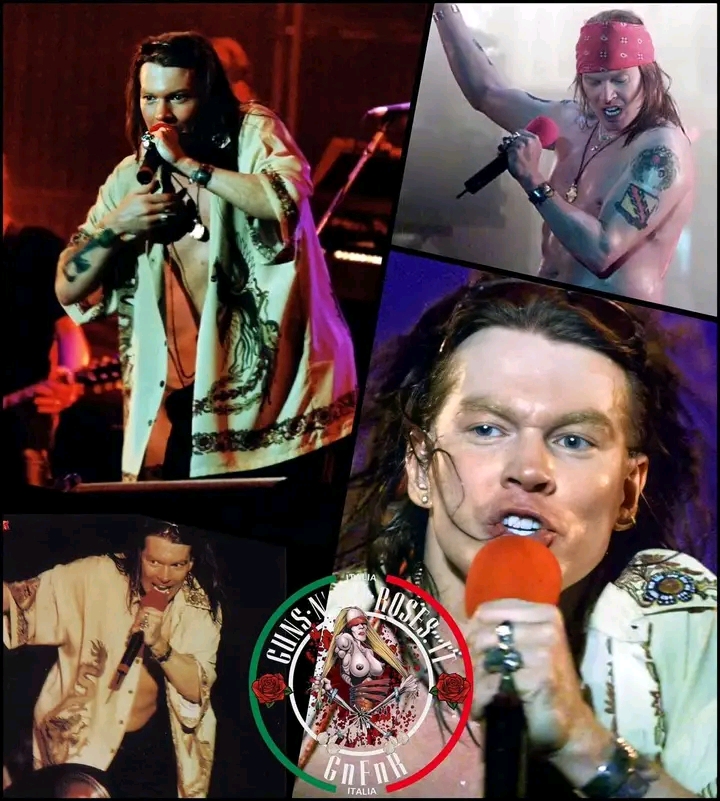
If you want to understand why Guns N’ Roses remain a myth as much as a band, you don’t start with an album. You start with a night. One night. January 14th, 2001 technically the early hours of January 15th—when GN’R stood in front of nearly 200,000 people at Rock In Rio III and reminded the world that chaos, ambition, and danger still ruled rock ’n’ roll.
This wasn’t just a concert. It was a resurrection, a provocation, and a warning shot.
A Crowd the Size of a City
Rock In Rio has always been big. But this? This was biblical. A sea of humanity stretched as far as the eye could see in Rio de Janeiro, Brazil—fans who had waited years to see what Guns N’ Roses had become after lineup implosions, delays, lawsuits, rumors, and silence.
Axl Rose was back on the biggest stage imaginable, carrying the weight of the band’s fractured legacy and the mystery of its future. No Slash. No Duff. Instead, a lineup that felt almost unreal: Robin Finck, Buckethead, Dizzy Reed, Tommy Stinson, Chris Pitman, and Brain. A version of GN’R many fans doubted until this night.
The Soundcheck That Became a Statement
Even before the official show, the soundcheck alone felt like a private concert for the lucky few close enough to hear it. Songs like “It’s So Easy,” “November Rain,” “My Michelle,” “Oh My God,” and “Knockin’ On Heaven’s Door” echoed through the emptying night air, a promise of what was coming.
This wasn’t nostalgia. This was preparation for war.
Welcome to the Jungle… Again
When “Welcome to the Jungle” finally exploded from the speakers, the crowd erupted like a living organism. Axl, dressed in red and black, sprinted across the stage with manic energy, sounding ferocious and defiant. Any doubts about his voice were obliterated in seconds.
From there, the band tore through “It’s So Easy” and “Mr. Brownstone,” proving this lineup could handle the old material with brute force and precision.
Then came “Live and Let Die,” complete with fireworks and mass hysteria, followed by “Oh My God,” a controversial industrial-era track that hit even harder live, daring the crowd to keep up.
Old Classics, New Monsters
Think About You” and “You Could Be Mine” kept the momentum relentless, before Robin Finck stunned the audience with a solo on “Sossego,” a moment that showcased the band’s experimental edge.
Then came the spine-tinglers.
“Sweet Child O’ Mine” turned 200,000 voices into one. “Knockin’ On Heaven’s Door” stretched into a massive communal singalong, the Brazilian crowd refusing to let the song end.
But this was also the unveiling of the future.
“Madagascar,” one of the most ambitious tracks from the long-gestating Chinese Democracy, hit with cinematic weight. Then the spotlight shifted to Buckethead.
Enter the Alien
Buckethead’s guitar solo wasn’t just a solo—it was a moment that divided rock fans forever. Masked, emotionless, otherworldly, he shredded and sculpted sound like no one before him. Later, his infamous “Chicken Binge” would turn the stage into something closer to performance art than a rock show.
Love it or hate it, you couldn’t look away.
November Rain Under Brazilian Skies
When “November Rain” arrived, time stopped. The piano intro drifted over the crowd as thousands held up lighters and hands. Axl delivered one of his most emotional performances of the song ever, the Brazilian night wrapping the melody in humid, electric tension.
This was followed by “Out Ta Get Me,” “Rocket Queen,” and then the title track “Chinese Democracy,” which—years before its official release—sounded massive, modern, and unapologetically ambitious.
Deep Cuts, Risks, and Total Control
As the set stretched deeper into the night, GN’R leaned into risk. “The Blues” (later known as Street of Dreams) floated with haunting beauty. “Patience” gave the crowd another chance to breathe. “Nightrain” slammed the accelerator back to the floor.
And still they weren’t done.
The Encore That Broke the Night
The encore felt less like a goodbye and more like a challenge. An Instrumental Jam bled into “My Michelle,” then “Silkworms,” one of the most divisive tracks of the era raw, aggressive, and completely unfiltered.
Finally, “Paradise City.”
The ultimate closer. Fireworks. Chaos. 200,000 people screaming the chorus as if their lives depended on it. When the last note rang out, it felt less like the end of a show and more like the end of an era.
Why This Night Still Matters
Rock In Rio 2001 wasn’t just a comeback it was a declaration. Guns N’ Roses proved they didn’t need to play it safe, didn’t need to chase approval, and didn’t need to recreate the past to command the present.
This was GN’R at their most polarizing, most ambitious, and most fearless.
Love this version of the band or hate it January 14th, 2001 remains one of the most audacious performances in rock history. A night when Guns N’ Roses stared down 200,000 people… and didn’t blink.
Leave a Reply