
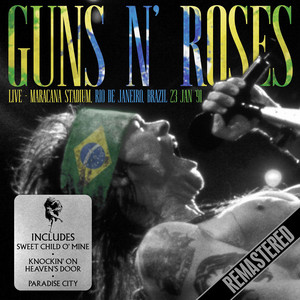
There are cover songs and then there are cultural takeovers. Guns N’ Roses’ version of “Knockin’ on Heaven’s Door” isn’t just a reinterpretation of Bob Dylan’s classic; it’s one of those rare moments where a band grabs a legendary song, drags it through their own chaos, pain, and excess, and somehow turns it into a defining anthem of an entire generation. Decades later, fans still argue: did Guns N’ Roses borrow the song, or did they make it immortal all over again?
When Guns N’ Roses first unleashed their take on “Knockin’ on Heaven’s Door” in the early ’90s, the band was at the absolute height of its powers—and its self-destruction. This was not the hungry Sunset Strip gang clawing for survival. This was a global juggernaut, a band so massive it felt like it could collapse under its own weight at any moment. And that tension between glory and ruin is exactly what seeps into every note of their version.
Bob Dylan’s original, written for the 1973 film Pat Garrett and Billy the Kid, is sparse, gentle, and resigned. It sounds like a man quietly accepting his fate. Guns N’ Roses flipped that emotional gravity outward. Their version feels like someone fighting fate, screaming into the sky, refusing to go quietly even while knowing the end is inevitable.
At the center of it all is Axl Rose’s voice, and this is where the magic and controversy begins. Axl doesn’t sing the song; he inhabits it. His delivery moves from weary vulnerability to aching defiance, stretching syllables until they sound like prayers on the verge of breaking. When he pleads, “Mama, take this badge off of me,” it no longer feels metaphorical. It feels personal. Raw. Exposed. As if he’s begging to be freed not just from a badge, but from fame, expectation, and the chaos swallowing his life.
Then there’s Slash, whose guitar work transforms the song from folk lament into stadium-sized catharsis. His solos don’t overpower the track they haunt it. Each note hangs in the air like smoke after a gunshot, slow-burning and emotional rather than flashy. It’s a reminder that Slash’s greatest strength was never speed, but feel. His guitar cries where words fall short, turning the song into something vast and cinematic.
What made Guns N’ Roses’ “Knockin’ on Heaven’s Door” explode wasn’t just the studio version it was the live performances. Onstage, the song became a communal ritual. Tens of thousands of voices singing along, lighters raised, crowds swaying as if sharing a collective confession. In an era defined by excess, ego, and volume, this was a moment of strange, almost spiritual stillness. For a few minutes, the most dangerous band in the world sounded human.
And timing mattered. The early ’90s were a turning point in rock music. Grunge was rising. Hair metal was dying. Cynicism was replacing glamor. Guns N’ Roses stood awkwardly between eras too raw to be polished, too theatrical to be grunge. “Knockin’ on Heaven’s Door” fit that crossroads perfectly. It was nostalgic without being soft, epic without being hollow. It felt like a farewell to something, even if no one could quite say what.
Critics, of course, were divided. Purists accused the band of overblowing a delicate song. Others argued that Axl’s dramatic delivery missed the quiet power of Dylan’s restraint. But fans didn’t care. For them, this wasn’t about honoring folk tradition it was about feeling something real. And Guns N’ Roses delivered that feeling in overwhelming doses.
The song also became unintentionally symbolic of the band’s own trajectory. As the years passed, as lineups fractured and tensions exploded, “Knockin’ on Heaven’s Door” began to feel like a prophecy. A band knocking on the edge of immortality… and implosion. Every time Axl sang it, it sounded less like a cover and more like a confession about the cost of living at the top.
Even today, the song refuses to fade. New generations discover it not through Dylan, but through Guns N’ Roses. It’s played at memorials, blasted in arenas, streamed millions of times by listeners who weren’t even born when the band recorded it. Few covers achieve that kind of legacy where the reinterpretation becomes a gateway rather than a footnote.
So why does Guns N’ Roses’ “Knockin’ on Heaven’s Door” still matter?
Because it captures something timeless: the sound of flawed people reaching for meaning in the middle of chaos. It’s not polite. It’s not subtle. It’s loud, emotional, and unapologetically human—just like the band that made it famous.
In the end, Guns N’ Roses didn’t replace Bob Dylan’s song. They built another doorway to it. And decades later, fans are still knocking—still listening—still arguing about which version cuts deeper.
That’s not just a great cover.
That’s rock history.
Leave a Reply