
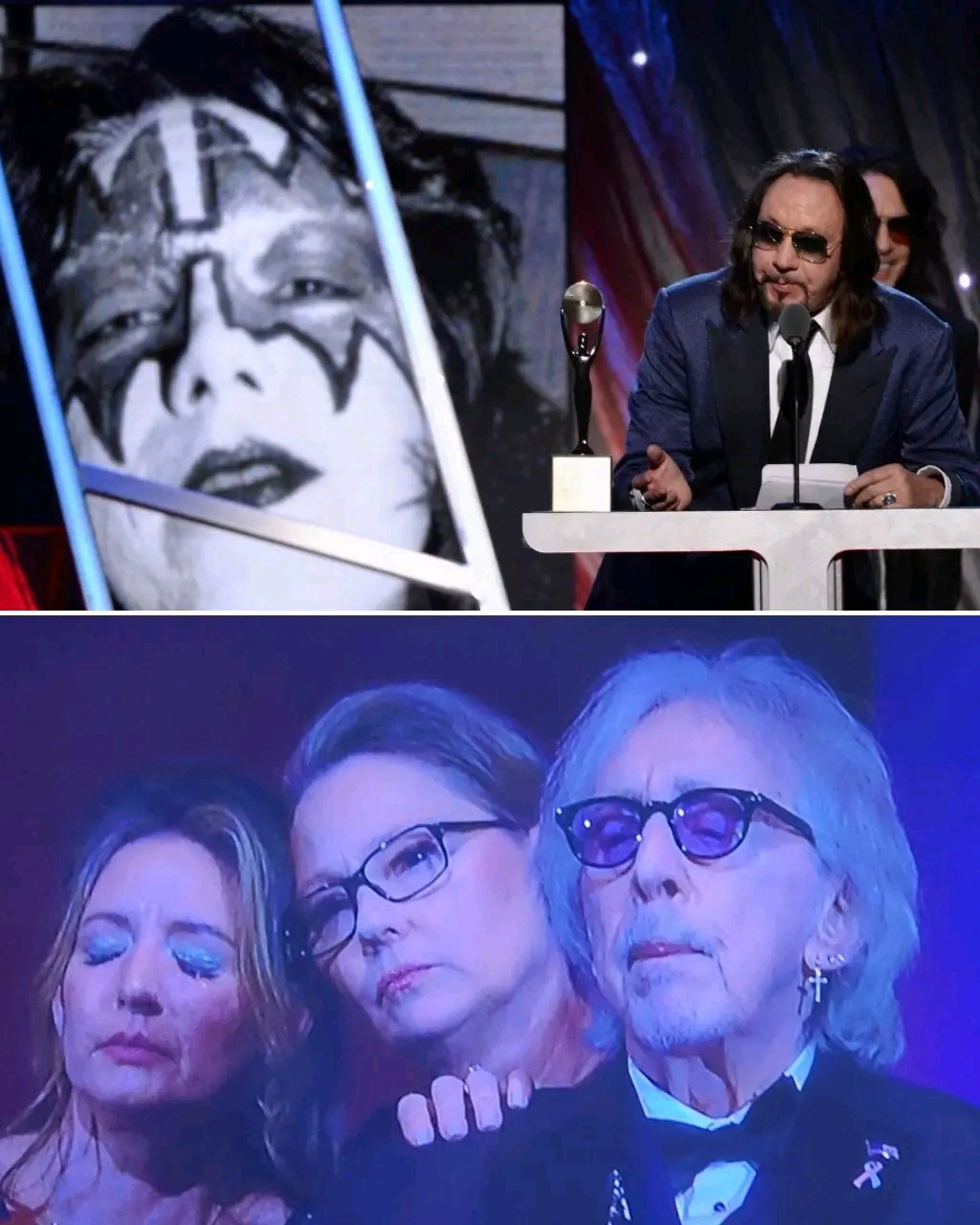
Nearly two months after the world lost Ace Frehley at 74, the Kennedy Center Concert Hall became something no KISS fan ever imagined it could be.
Quiet.
No smoke.
No fire.
No screaming guitars ripping through the air.
Just silence thick, heavy, and emotional as Ace Frehley’s surviving KISS bandmates took the stage to honor the man who helped change rock music forever. It was the 2025 Kennedy Center Honors, and for the first time in the band’s legendary history, the loudest sound in the room was heartbreak.
A Night That Felt Unreal
For decades, Ace Frehley was the Spaceman — untouchable, electric, larger than life. He wasn’t supposed to be remembered in hushed tones or spoken of in the past tense. Yet there they stood, stripped of makeup, stripped of armor, facing a reality no amount of distortion could drown out.
This wasn’t a celebration of excess.
It was a farewell.
The room fell silent as Gene Simmons, Paul Stanley, and Peter Criss took their seats. Their faces told a story fans had rarely seen so openly: grief without disguise. Legends who once ruled arenas now looked like brothers who had lost one of their own.
“He Was the Spark”
When they finally spoke, their words didn’t come easily.
They didn’t talk first about sold-out tours, platinum records, or history-making stage shows. Instead, they talked about Ace the human being — the rebel with a crooked smile, the unpredictable genius who walked into a New York rehearsal room and unknowingly rewired the future of rock music.
“He was the spark,” one of them said quietly. “Without Ace, there is no KISS.”
They described him as fearless and flawed, brilliant and chaotic — a man who refused to play by the rules and accidentally invented new ones. Ace didn’t just play guitar; he made it speak. His solos weren’t polished — they were dangerous, emotional, alive.
And that danger is exactly what made him legendary.
No Guitars. No Costumes. Just Truth.
The absence of spectacle was almost painful.
Fans watching around the world expected something loud — some final explosion of sound in Ace’s honor. Instead, the Kennedy Center offered something far more devastating: restraint
Each pause between words felt like a held breath. Each mention of Ace’s name tightened the room. These weren’t rock gods performing. These were men remembering a brother they loved, fought with, laughed with, and ultimately lost.
For a band known for defying emotion with volume, this vulnerability cut deeper than any power chord ever could.
Then Came the Moment No One Was Ready For
Just when it seemed the night couldn’t get heavier, the hardest moment arrived.
Ace Frehley’s daughter stepped onto the stage to accept the honor on his behalf.
The applause was immediate — and then it softened, as if the room instinctively knew this wasn’t a moment for noise.
She stood there, small beneath the lights, holding an award that represented not just musical history, but a lifetime of memories, struggles, and love. When she tried to speak, her voice trembled.
Then it broke.
Tears streamed down her face as she fought to finish even a single sentence. She spoke of her father not as a rock icon, but as Dad. The man who tucked her in. The man who struggled, laughed, and kept going. The man behind the makeup.
And in that moment, the illusion shattered completely.
Behind the Face Paint Was a Father
For decades, Ace Frehley existed as myth the Spaceman, the rebel, the guitar god who seemed untouchable. But standing there, watching his daughter struggle through her grief, the world was reminded of something painfully simple:
Legends have families.
Icons have children.
And fame does not shield the heart from loss.
Her tears weren’t theatrical. They weren’t staged. They were raw, uncontrollable, and devastatingly real. Cameras caught Gene Simmons wiping his eyes. Paul Stanley stared at the floor, jaw clenched. No one moved.
Rock ’n’ roll had gone completely silent.
A Legacy That Refuses to Die
What made the night unforgettable wasn’t just the grief — it was the realization of what Ace Frehley truly left behind.
Every guitarist who ever bent a note too far.
Every band that dared to be weird, loud, or dangerous.
Every fan who picked up a guitar because something about Ace felt possible.
He didn’t just help create KISS. He helped give rock music permission to be reckless again.
And that legacy echoed through the hall louder than any amplifier ever could.
The Final Truth of the Night
As the ceremony closed, there was no final song. No dramatic farewell.
Just standing ovations, misty eyes, and the unspoken understanding that something irreplaceable had been honored and lost.
The 2025 Kennedy Center Honors didn’t just recognize Ace Frehley’s contribution to music. It revealed the cost of greatness, the humanity behind the legend, and the love that remains long after the spotlight fades.
Because behind the face paint, behind the fame, behind the noise, there was a father deeply loved.
And a legacy that will never, ever fade.
Leave a Reply