
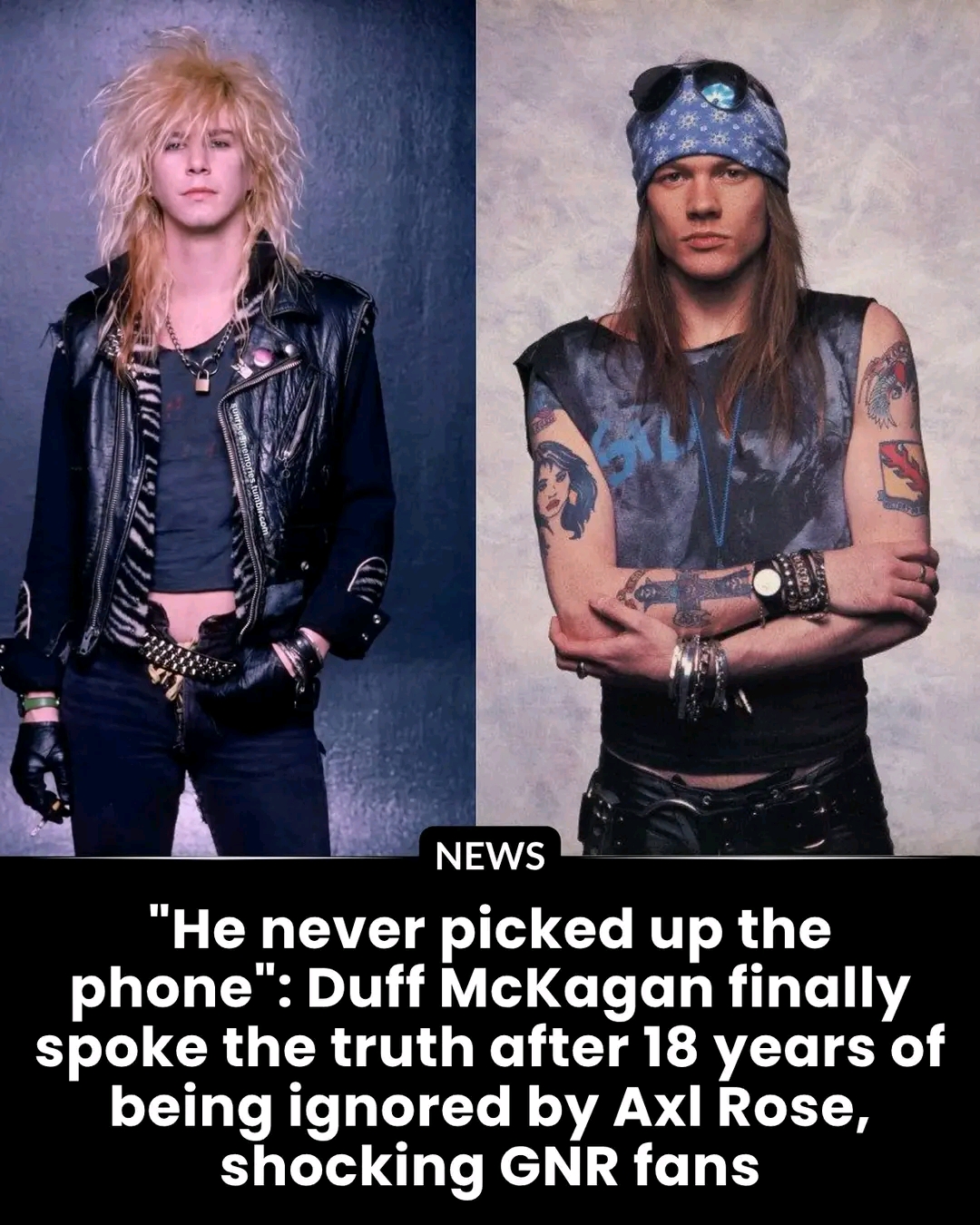
For nearly two decades, one of the most explosive friendships in rock history existed in a state more brutal than a screaming guitar solo gone wrong: total silence.
No calls.
No texts.
No late-night apologies.
No “Hey man, how you been?”
According to bassist Duff McKagan, Axl Rose — the volatile, mythic frontman of Guns N’ Roses — “never picked up the phone” for 18 long years. And for fans who grew up worshipping Appetite for Destruction, that confession lands like a gut punch.
This wasn’t just a band breakup.
It was a complete emotional blackout.
And yet, against all odds, that silence would eventually give birth to one of the greatest comebacks in music history — a reunion tour so massive, so unlikely, it would go on to gross $584 million, rewriting rock economics forever.
So what really happened during those lost years?
And what single moment finally broke the ice between rock’s most infamous brothers-in-arms?
The Silence That Screamed Louder Than Any Song
By the late 1990s, Guns N’ Roses had become less a band and more a battlefield. Lawsuits. Ego clashes. Public insults. Lineup changes that left fans dizzy. Axl Rose retreated into near-total isolation while Duff McKagan rebuilt his life after addiction nearly killed him.
But the most shocking part, Duff now reveals, wasn’t the chaos — it was the absence.
For 18 years, Axl never picked up the phone,” Duff has said bluntly.
No screaming matches.
No dramatic confrontations.
Just… nothing.
In rock mythology, feuds are loud. Think Gallagher brothers trading insults or Metallica fighting it out in documentaries. But Guns N’ Roses? Their feud was colder. More surgical. A silence so absolute it felt permanent.
Fans assumed reconciliation was impossible.
Industry insiders wrote the band off as a cautionary tale.
Even friends believed the damage was irreversible.
Because when Axl Rose cuts someone off, history suggests the door is welded shut.
Duff’s Survival Changed Everything
Here’s the twist: the silence didn’t end with anger — it ended with growth.
During those 18 years, Duff McKagan nearly died from alcohol abuse. His recovery didn’t just save his life; it reshaped his worldview. He went back to school. Became a writer. Became reflective. Calm. Grounded.
The reckless kid from Seattle was gone.
And Axl — always more complex than his tabloid image — noticed.
Behind the scenes, whispers began circulating. Small, indirect messages passed through mutual contacts. Not apologies. Not invitations. Just awareness.
The wall hadn’t cracked yet — but it had started to sweat.
The Moment That Broke the Ice
So what finally ended nearly two decades of silence?
Not money.
Not contracts.
Not pressure from promoters.
It was a human moment.
According to those close to the band, Axl reached a point where time — and mortality — became louder than resentment. People age. Friends disappear. Legends don’t last forever.
When the phone finally rang, it wasn’t explosive.
It was quiet.
No grand speeches.
No emotional monologues.
Just two men acknowledging the past without reliving it.
Duff later described it as “surprisingly normal.”
After 18 years of mythology, the conversation wasn’t about Guns N’ Roses at all.
It was about life.
From Silence to Stadiums
What followed shocked the entire music industry.
The “Not In This Lifetime” reunion tour — a name that openly mocked how impossible the reunion once seemed — became a cultural earthquake. Stadiums sold out in minutes. Fans cried. Critics scrambled to rewrite history.
And the numbers?
$584 million.
One of the highest-grossing tours of all time.
But what made it legendary wasn’t just the cash — it was the chemistry. Against expectations, Axl and Duff didn’t just coexist onstage. They clicked.
No meltdowns.
No walk-offs.
No sabotage.
The man who once wouldn’t pick up the phone was now showing up — night after night — delivering career-defining performances.
Why This Comeback Hit Different
Rock history is full of reunions. Most feel transactional. Nostalgia machines designed to cash in before the lights go out.
This wasn’t that.
This was redemption.
The long silence gave both men space to evolve into versions of themselves that could finally coexist. Had they reunited earlier, it likely would’ve imploded. The 18-year gap wasn’t a failure — it was a necessary exile.
Sometimes legends need to disappear before they can return.
The Real Legacy of Guns N’ Roses
What Duff McKagan’s confession really exposes isn’t dysfunction — it’s humanity.
Behind the leather, the chaos, the screaming crowds, Guns N’ Roses was always a band of wounded, brilliant men trying to survive themselves.
Axl Rose didn’t just ghost a bandmate — he protected himself in the only way he knew how.
Duff didn’t just wait — he grew.
And when the silence finally ended, it wasn’t about reliving the past.
It was about finishing the story.
The Takeaway Fans Can’t Ignore
For 18 years, the phone didn’t ring.
And yet, when it finally did, it created one of the most profitable — and emotionally resonant — comebacks rock has ever seen.
Because sometimes, the loudest thing a legend can do…
…is finally say hello again.
And Guns N’ Roses proved that even the most volatile friendships can rise from the ashes — louder, wiser, and more powerful than ever before.
Leave a Reply