
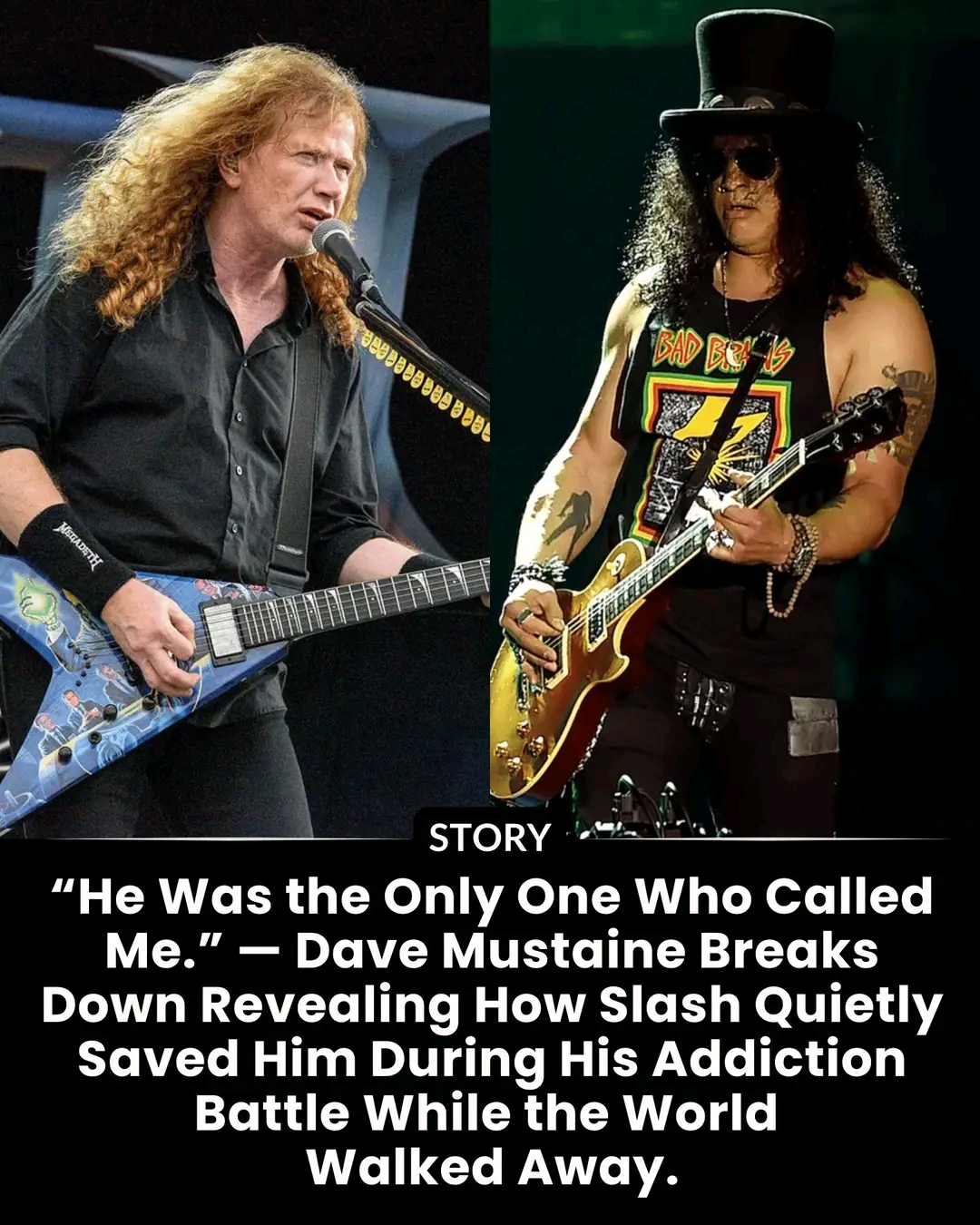
The history of rock and metal is littered with feuds, broken friendships, and rivalries that burned brighter than the stage lights. Few stories seemed more entrenched in myth than the supposed bad blood between Dave Mustaine, the fiery mastermind of Megadeth, and the inner circle of Guns N’ Roses. For decades, fans were fed a steady diet of headlines about ego clashes, industry politics, and old wounds that never healed.
But behind the noise, behind the gossip, behind the carefully crafted narratives of rock warfare, something far more human was happening and almost no one knew about it.
In a stunning revelation, Dave Mustaine has now pulled back the curtain on one of the darkest chapters of his life and the one person who reached out when everyone else disappeared.
That person was Slash.
When the Phones Stopped Ringing
Addiction is often glamorized in rock history the excess, the chaos, the wild survival stories. But Mustaine has never sugarcoated his reality. At the height of his substance abuse battle, he wasn’t living the myth. He was living the nightmare.
“I was isolated,” Mustaine admitted. “People didn’t know what to say. Some didn’t want to get involved. Others just vanished.”
As the media speculated and fans debated his future, Mustaine found himself alone with his demons. Friends went quiet. Industry allies kept their distance. The world, as he describes it, walked away.
Then the phone rang.
“It was Slash,” Mustaine said. “He was the only one who called me.”
The Rivalry That Wasn’t
To the outside world, this made no sense. Guns N’ Roses and Megadeth were often portrayed as opposing forces different scenes, different attitudes, different tribes of fans. The press loved framing rock legends as enemies. Conflict sold records. Brotherhood didn’t.
But Mustaine revealed that beneath the surface, there was a shared understanding between him and Slash that few others could grasp.
“Slash knew what it was like,” Mustaine explained. “He’d been through it. He didn’t judge me. He didn’t preach. He just checked in.”
That simple act a phone call with no agenda became a lifeline.
Quiet Support, No Cameras, No Credit
What makes the story even more powerful is what Slash didn’t do. He didn’t announce his support. He didn’t leak it to the press. He didn’t turn it into a redemption headline or a PR moment.
“There was no ‘look at me,’” Mustaine said. “He wasn’t trying to save face or score points. He was just being a human being.”
In an industry obsessed with image, Slash chose privacy over publicity. While tabloids continued pushing stories of rivalries and grudges, he was quietly making sure a fellow musician didn’t fall off the edge.
It wasn’t about bands. It wasn’t about genres. It wasn’t even about history.
It was about survival.
Rock Bottom Isn’t Loud It’s Silent
Mustaine’s account shatters one of the biggest misconceptions about addiction: that rock bottom is explosive. According to him, it’s often terrifyingly quiet.
“It’s not the chaos that gets you,” he said. “It’s the silence. When nobody checks on you. When you start thinking you don’t matter anymore.”
That’s where Slash’s calls mattered most. They weren’t dramatic conversations. Sometimes they were short. Sometimes awkward. Sometimes just a few words.
But they broke the silence.
“They reminded me I wasn’t invisible,” Mustaine confessed.
Two Legends, One Shared Battle
Both men have publicly confronted addiction and lived to tell the tale. Both have scars physical, emotional, and spiritual from years on the edge. That shared experience created a bond stronger than any fabricated rivalry.
“Only someone who’s been there knows how close you are to losing everything,” Mustaine said.
Slash didn’t try to fix him. He didn’t try to control his choices. He simply stayed connected a radical act in a culture that often abandons people when they’re no longer convenient.
The Truth the Headlines Missed
For years, fans believed the story they were sold: egos clashing, legends divided, bridges burned beyond repair. Mustaine’s revelation exposes how shallow those narratives were.
“People love drama,” he said. “But they don’t always love the truth.”
The truth is quieter. Messier. More meaningful.
While cameras focused elsewhere, a guitar god picked up the phone and made sure another didn’t disappear.
A Debt That Can’t Be Repaid
Mustaine is clear that he doesn’t frame Slash as a savior in some cinematic sense. Recovery, he emphasizes, was still his responsibility. The fight was still brutal. The work was still his to do.
But timing matters.
“That call came when I needed it,” Mustaine said. “And I’ll never forget that.”
There are debts in life that can’t be repaid with money, awards, or public praise. They’re paid in gratitude — and in telling the truth when it finally matters.
Brotherhood Over Myth
In the end, this isn’t just a rock story. It’s a human one. A reminder that behind the leather jackets, the stage pyrotechnics, and the screaming crowds are people who break, who struggle, and who sometimes only need one person to care.
Dave Mustaine’s revelation doesn’t rewrite rock history it humanizes it.
And it proves that when the world walks away, sometimes salvation doesn’t come with applause.
Sometimes, it comes with a quiet phone call from Slash.
Leave a Reply