
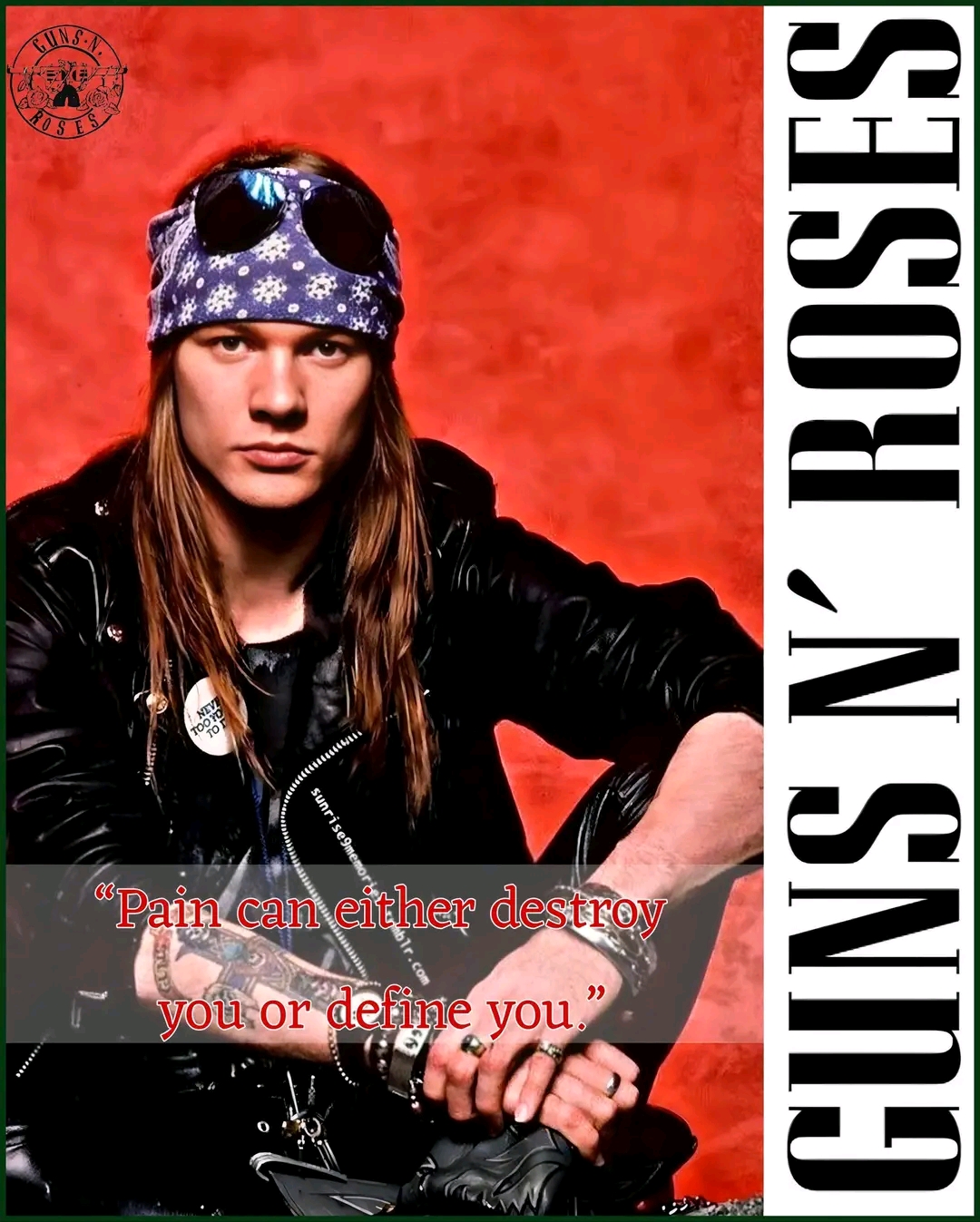
Pain can either destroy you or define you. For Axl Rose, it did something far more explosive: it became his voice.
That voice — snarling, howling, whispering, screaming — didn’t just sing songs. It bled. It carried trauma, rage, vulnerability, and survival in every cracked note. And in the late 1980s, when Guns N’ Roses detonated onto the world stage, that voice became the sound of rebellion for an entire generation that felt unheard.
Before the fame, before the stadiums, before Appetite for Destruction rewrote rock history, there was William Bruce Rose Jr. — a kid shaped by instability, abuse, and emotional chaos. His childhood was not a backdrop; it was the fuel. And unlike many artists who bury their scars, Axl put his right up against the microphone.
From the first scream of “Welcome to the Jungle,” listeners knew this wasn’t polished rock fantasy. This was danger. This was pain with teeth.
Axl’s voice was never about perfection. It was about truth. He could switch from a banshee wail to a wounded croon in seconds, mirroring the emotional whiplash of someone who had lived through too much, too fast. That unpredictability wasn’t accidental — it was survival instinct turned into art.
Critics mocked him. Rivals feared him. Fans felt seen by him.
While hair metal bands sang about parties and excess, Axl sang about paranoia, heartbreak, addiction, betrayal, and inner demons. Songs like “Out Ta Get Me,” “My Michelle,” and “Mr. Brownstone” weren’t fantasies — they were confessions. His voice sounded like someone constantly on the edge because, emotionally, he often was.
And then there were the ballads.
“Sweet Child O’ Mine” showed a softness few expected, proving that the same voice capable of fury could also cradle vulnerability. “Don’t Cry” and “November Rain” turned emotional collapse into operatic grandeur. Axl didn’t just sing pain — he orchestrated it, letting it swell, explode, and fall apart in real time.
What made Axl Rose different wasn’t just his range — though his vocal range remains one of the widest ever recorded in rock. It was the courage to sound uncomfortable. To let his voice crack. To scream when others smoothed things out. To let silence hang where polish would’ve been safer.
That fearlessness came at a cost.
As fame exploded, so did the pressure. Axl became known as volatile, unpredictable, and difficult. Concert delays. Walkouts. Public meltdowns. The headlines painted him as a villain. But behind the chaos was a man struggling to protect the one thing he had always used to survive: his voice, his control, his truth.
Every breakdown, every outburst, every retreat from the spotlight added another layer to the myth — and the music.
By the early 1990s, Guns N’ Roses had become the biggest band in the world, and Axl was its emotional epicenter. The Use Your Illusion era showed an artist unafraid to unravel in public. The songs were longer, darker, more ambitious. His voice carried exhaustion, anger, longing, and defiance often all in the same track.
Then came the silence.
For years, Axl vanished. His voice — once everywhere — became a mystery. Fans wondered if it was gone forever, destroyed by time, damage, and demons. But survival has always been Axl Rose’s quiet superpower.
When he returned, older and changed, the voice was different but still unmistakably his. Less reckless, more controlled, yet still carrying echoes of everything it had survived. And when he rejoined Slash and Duff McKagan, standing on stage again as Guns N’ Roses, the roar from fans wasn’t just nostalgia it was recognition.
They weren’t cheering perfection. They were cheering endurance.
Axl Rose never fit the mold of a traditional frontman. He wasn’t charming in interviews. He wasn’t easy to understand. He didn’t soften his edges to please critics. And that’s exactly why his voice mattered so much. It gave permission to be broken, angry, emotional, and loud about it.
In an industry obsessed with image, Axl delivered authenticity — even when it was ugly.
Today, his influence is everywhere. Modern rock, metal, and alternative singers still chase the rawness he made famous. But few can replicate what made Axl Rose truly dangerous: the willingness to let pain lead the performance.
Because Axl’s voice wasn’t just trained — it was earned.
Every scream carried history. Every whisper carried survival. And every time he stepped up to the mic, it felt like a man daring the world to look directly at what hurt him and refusing to look away himself.
Pain tried to destroy Axl Rose.
Instead, he turned it into fire.
And decades later, that fire still burns loud, imperfect, and impossible to ignore.
Leave a Reply