
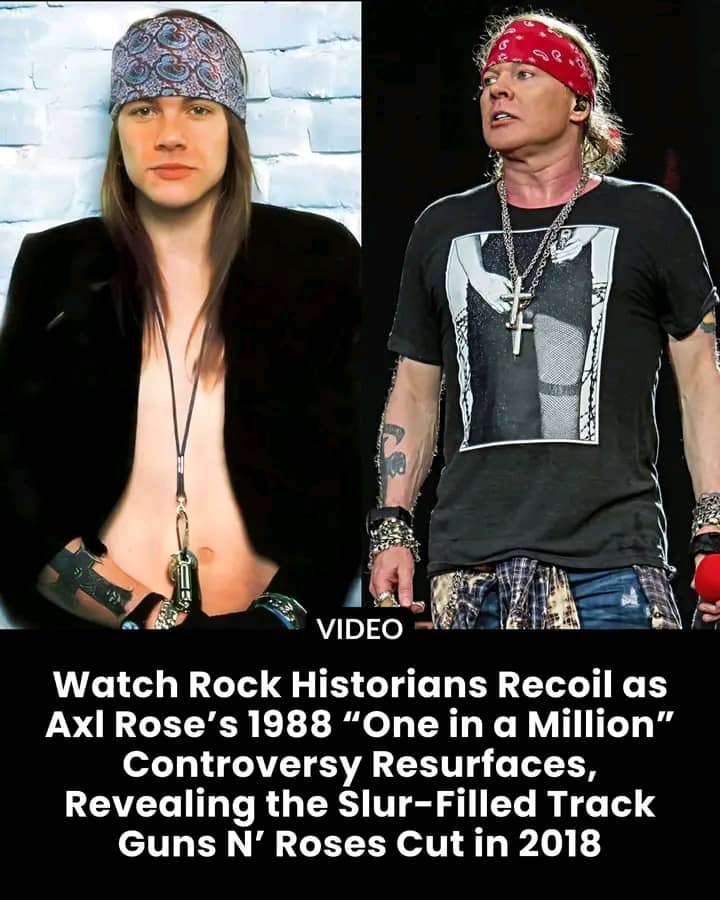
Rock history has never been gentle, but few moments hit with the same explosive force as the resurfacing of Guns N’ Roses’ most infamous song — the one even the band eventually buried.
Now, decades later, “One in a Million” is back in the spotlight, and rock historians, journalists, and fans are recoiling all over again as the dark truth behind the track resurfaces with brutal clarity.
Because in 1988, long before social media outrage cycles, long before cancel culture became a concept, Axl Rose lit a match that would burn for decades. And the echoes of that firestorm are shaking the rock world once again.
The Song Axl Rose Never Escaped
When “One in a Million” dropped on G N’ R Lies in 1988, it was wrapped in acoustic guitar and quiet presentation — but its lyrics detonated like a bomb.
Axl Rose didn’t just push boundaries.
He obliterated them.
The song infamously contained vicious racial and homophobic slurs, casually dropped as if they were part of everyday street vocabulary. Rock audiences had heard anger before — but this wasn’t just anger. This was gasoline poured on cultural fault lines.
The backlash was instant, fierce, and international.
Politicians denounced it.
LGBTQ groups condemned it.
Civil rights leaders expressed outrage.
Fans fought amongst themselves.
And Axl Rose?
He went on the defensive, then the offensive, then back again — in interviews, on stage, in magazines — offering explanations, justifications, and occasionally a shrug.
But the controversy never stopped following him.
Three Decades Later The Song Is “Silenced”
Fast-forward to 2018.
Guns N’ Roses were preparing to celebrate one of the most monumental landmarks in rock history: the Appetite for Destruction anniversary box set.
A massive release.
A luxury tribute.
A historical preservation of their rise to global domination.
But one track was left behind.
“One in a Million” was removed. Not remastered. Not included. Not mentioned. Not defended.
For the first time in the band’s career, Guns N’ Roses made a deliberate, public erasure of their own material—an admission that a line had been crossed so deeply, so painfully, that the only answer was silence.
Industry insiders said it felt like a funeral for a song.
Rock historians were stunned.
Fans were divided.
Axl himself stayed silent—perhaps the loudest silence of all.
Why It Still Haunts the Band Today
As the 2020s rolled in, culture began re-examining iconic artists with a new lens. And suddenly, “One in a Million” was trending again.
Younger listeners—many discovering GNR for the first time—reacted with shock and disbelief.
How could a band capable of “Sweet Child O’ Mine,” “Patience,” and “November Rain” also produce something so venomous?
Why didn’t the band stand together on this issue?
And how did the song last so long before being pulled?
Historians began revisiting old interviews, old footage, old print ads — trying to reconstruct the mindset of a band at war with the world and themselves.
The result?
A wave of videos, documentaries, and reaction clips showing historians and experts literally recoiling as they revisit the long-ignored track.
Some slammed the song as indefensible.
Some framed it as a product of its time.
Some blamed Axl’s upbringing.
Some blamed the era’s chaotic rock culture.
But nobody, not one reputable historian, denied the seismic shockwave the song left behind.
Inside the 1988 Firestorm What Really Happened
To outsiders, “One in a Million” felt like a random act of lyrical violence.
But those who lived inside the rock scene of the late ’80s knew better.
Axl Rose wasn’t filtering anything.
He wasn’t smoothing edges.
He wasn’t strategizing.
He was channeling raw personal anger, shaped by his unstable youth in Lafayette, shaped by culture clashes on the streets of Los Angeles, shaped by paranoia, defensiveness, and a desperate desire to shock.
The backlash wasn’t just moral — it was political.
Celebrities denounced him.
Advocacy groups plotted boycotts.
Some cities attempted to block Guns N’ Roses concerts.
The band itself wasn’t unified either.
Slash and Duff were blindsided.
Management panicked.
Labels debated pulling the track entirely — and some copies were nearly recalled.
But Axl Rose refused.
The song stayed.
And for years, the controversy only grew.
2018: The Silent Rejection Heard Around the World
Three decades later, after numerous reunions, breakups, disappearances, and comebacks… the decision finally came:
“One in a Million” would be removed from the 2018 box set.
No statement.
No apology.
No explanation.
Just an omission — cold, quiet, absolute.
Fans quickly noticed.
Critics wrote think-pieces.
Historians called it “the first true self-cancellation in rock history.”
It was the moment the band effectively said:
“This part of our past does not represent us anymore.”
A symbolic burial.
A closing of a chapter many hoped would never reopen.
And Now It’s Back in the Spotlight Again
Today, in an era where the past never truly dies online, the song has resurfaced as younger generations discover it for the first time.
Reaction videos are exploding.
Podcast hosts are stunned.
Music historians are dissecting every lyric with shock and uneasy fascination.
The internet is split in half—again.
The debate is raging—again.
Axl’s past is haunting the present—again.
For a song the band tried to bury, “One in a Million” has returned with more force than ever.
The Final Verdict
Whether fans defend it, condemn it, or analyze it, one thing is undeniable:
“One in a Million” remains one of the most controversial, explosive, and culturally radioactive songs in rock history.
And now that the controversy has resurfaced, it’s clear this track will continue to spark outrage, debates, and reconsiderations for decades to come.
Guns N’ Roses may have erased it in 2018.
But the world?
The world never forgets.
Leave a Reply