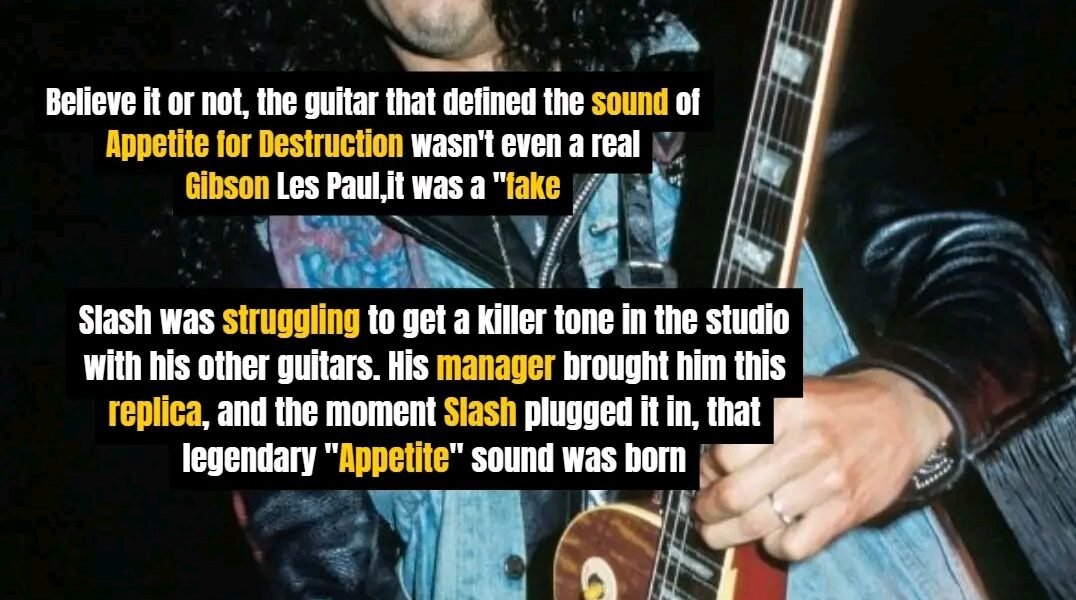
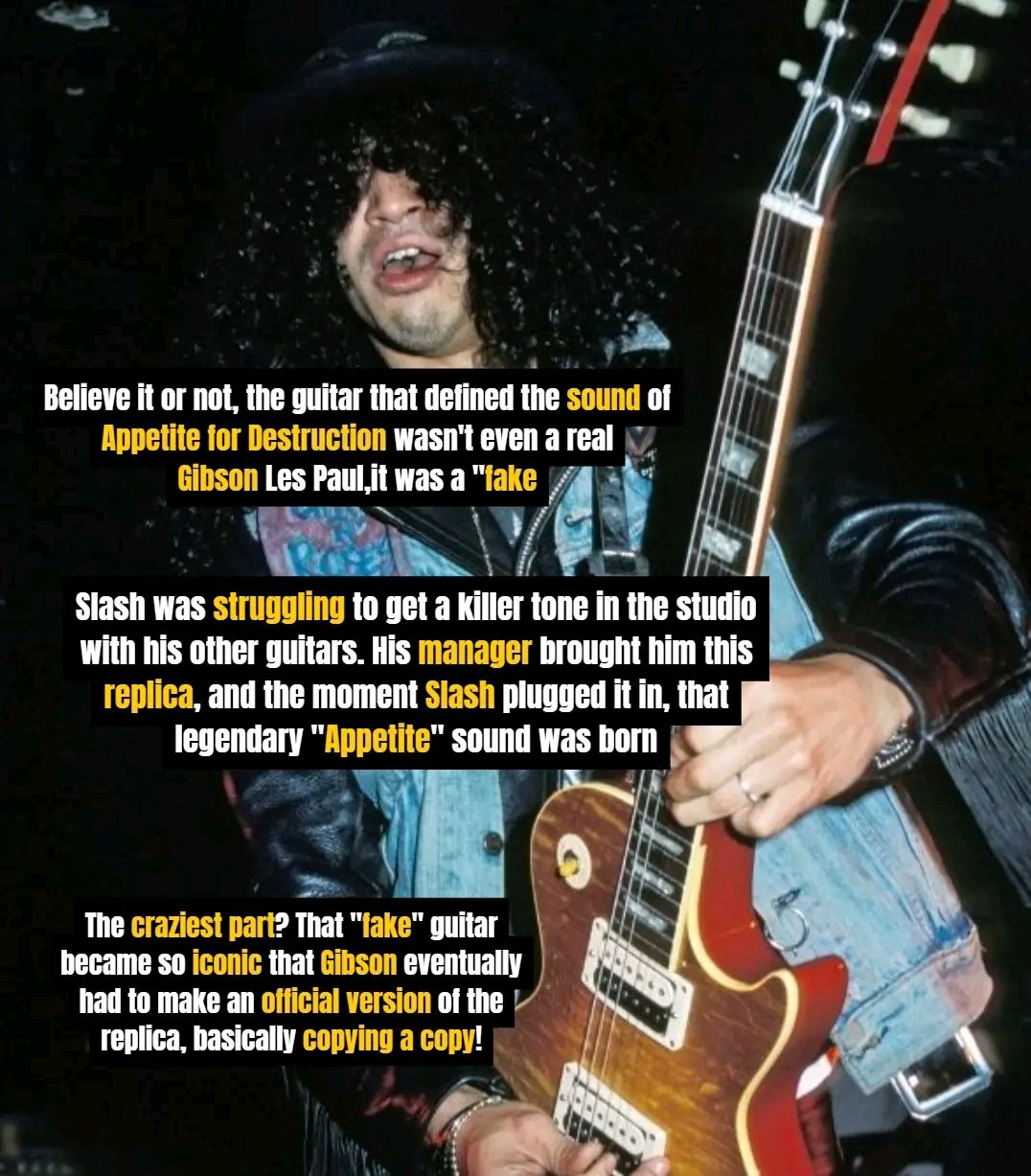
In 1986, during the recording sessions for Appetite, Slash was struggling to find a good studio sound with his BC Rich and Jackson guitars His manager,…

Before became the most dangerous rock band on the planet… before Sweet Child O’ Mine exploded across radios worldwide… before millions of fans worshipped the screaming solos of …
There was a secret hiding inside the studio.
And almost nobody knew the truth.
The legendary guitar sound that powered Appetite for Destruction one of the greatest rock albums in history did not come from a real Gibson Les Paul at all.
It came from a handmade replica built by a little-known craftsman in California.
Even more unbelievable? The man who created the instrument died before he ever saw how his work changed music forever.
This is the emotional, shocking, and almost unbelievable story behind the “fake” guitar that created one of rock’s most iconic sounds.
THE PROBLEM THAT WAS DRIVING SLASH CRAZY
In 1986, Guns N’ Roses were still hungry, dangerous, and unknown. The band was recording what would eventually become Appetite for Destruction, but inside the studio, Slash was fighting a frustrating battle.
He couldn’t find the sound he wanted.
At the time, Slash had been experimenting with BC Rich and Jackson guitars, but according to people close to the sessions, the tone simply wasn’t delivering the thick, bluesy aggression he heard in his head.
The band needed something bigger.
Something dirtier.
Something unforgettable.
And time was running out.
That’s when manager Alan Niven stepped in and unknowingly altered rock history forever.
ENTER KRIS DERRIG THE UNKNOWN GENIUS
Niven reportedly discovered a handcrafted Les Paul-style guitar built by talented luthier Kris Derrig at MusicWorks in Redondo Beach, California.
At first glance, the guitar looked like a classic Gibson Les Paul Standard.
It even had the Gibson logo on the headstock.
But here’s the twist that still shocks guitar fans decades later:
It wasn’t a Gibson at all.
The instrument was entirely custom-built by Derrig, who had become respected among musicians for creating astonishingly accurate Les Paul replicas during an era when genuine vintage Gibsons were becoming difficult and expensive to obtain.
And the moment Slash plugged it in, everything changed.
THE SOUND THAT CREATED A ROCK MONSTER
The guitar featured a breathtaking flamed maple top, giving it the same gorgeous visual style as a late-1950s Les Paul.
But the real magic happened under the hood.
Loaded with Seymour Duncan Alnico II Pro pickups and paired with a modified Marshall amplifier, the guitar unleashed a sound unlike anything else in the studio.
Suddenly, Slash found it.
That snarling, emotional, aggressive tone.
The sound was raw yet melodic.
Violent yet beautiful.
And it became the heartbeat of Appetite for Destruction.
That “fake” Les Paul was used to record many of the album’s most iconic moments, including:
Sweet Child O’ Mine
Welcome to the Jungle
Paradise City
Rocket Queen
Those songs would eventually redefine hard rock music and turn Guns N’ Roses into global superstars.
Millions of fans fell in love with the guitar tone without realizing it came from a handmade replica built by an almost unknown craftsman.
THE TRAGIC TWIST THAT BREAKS HEARTS
What makes the story even more emotional is what happened next.
Before Appetite for Destruction exploded into a worldwide phenomenon, Kris Derrig tragically passed away from cancer.
He never got to fully witness the impact his guitar had on music history.
He never saw stadiums filled with fans screaming every Slash solo.
He never watched Sweet Child O’ Mine become one of the biggest rock songs ever recorded.
And he never knew his handmade creation would become one of the most legendary guitars in modern music.
For many guitar enthusiasts, that tragic detail transforms the story from rock trivia into something deeply human.
A gifted craftsman unknowingly helped create a musical revolution… then disappeared before the world could thank him.
THE IRONY THAT STILL STUNS GUITAR FANS
Normally, major guitar companies would be furious about replicas carrying their branding.
But in one of the strangest twists in music history, eventually embraced the mythology instead of fighting it.
As the legend of Slash’s Derrig-built guitar spread through the music world, fans became obsessed with the instrument.
Collectors talked about it endlessly.
Guitar forums exploded with debates.
Musicians desperately tried recreating the famous Appetite tone.
Then came the moment nobody expected.
In 2010, Gibson officially released the Slash Appetite Les Paul essentially creating a factory-made replica of a non-Gibson replica.
Yes, you read that correctly.
One of the world’s most famous guitar companies ended up reproducing a copy of their own guitar because the copy had become more legendary than many originals.
The irony was almost too perfect.
WHY THE GUITAR BECAME LEGENDARY
Part of what makes the Derrig Les Paul story so fascinating is that it represents the rebellious spirit of rock music itself.
Nothing about Guns N’ Roses was polished or conventional.
The band broke rules constantly.
And somehow, even their most iconic guitar wasn’t what people believed it was.
That unexpected combination of imperfections helped create magic.
Slash’s playing style, the modified Marshall amp, the Alnico II pickups, and the raw energy of Guns N’ Roses all collided at the perfect moment in time.
The result became one of the most recognizable guitar tones ever captured on tape.
Even today, guitar players around the world still spend thousands of dollars chasing that exact sound.
SLASH NEVER LOOKED BACK
Over the years, Slash became forever associated with Les Paul guitars, eventually partnering heavily with Gibson and releasing multiple signature models.
But hardcore fans know the truth behind the myth.
The sound that launched the Guns N’ Roses empire came from something much stranger and more legendary than a standard factory guitar.
It came from a handmade dream crafted by a passionate builder who never lived to see his impact.
And perhaps that’s why the story continues to fascinate rock fans decades later.
Because underneath the fame, the screaming crowds, and the millions of albums sold lies a deeply emotional reality:
One unknown craftsman helped shape the sound of an entire generation.
THE LEGACY OF A “FAKE” THAT BECAME IMMORTAL
Today, the Derrig-built Les Paul is more than just a guitar.
It’s a symbol of rock mythology.
A reminder that greatness sometimes comes from unexpected places.
And proof that history can be changed by people whose names the world almost forgot.
Without Kris Derrig’s craftsmanship, Appetite for Destruction may never have sounded the way it did.
Without that guitar, the opening riff of Welcome to the Jungle might never have terrified and thrilled listeners the same way.
And without that mysterious replica, one of the greatest rock albums ever made may have sounded completely different.
In the end, the “fake” guitar became more real than anyone could have imagined.
It didn’t just create songs.
It created history.