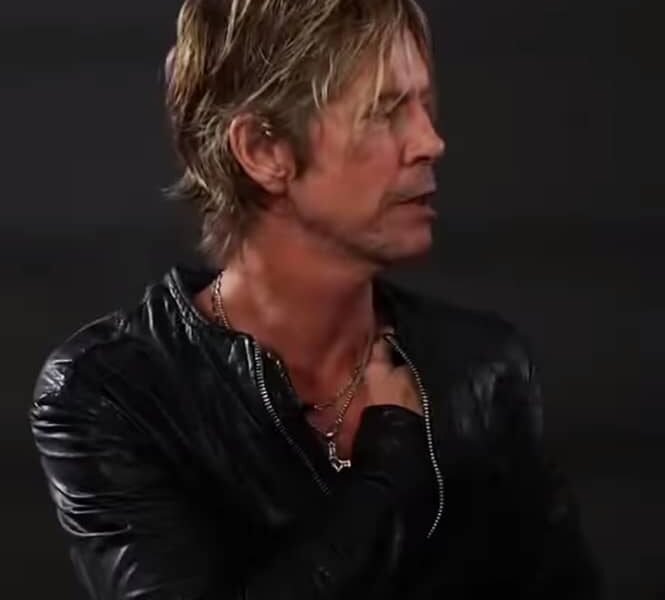
Duff McKagan explains why Guns N’ Roses rejected Paul Stanley’s offer to produce Appetite for Destruction….

Before Appetite for Destruction transformed Guns N’ Roses from a dangerous Los Angeles club band into one of the biggest rock acts on the planet, the group faced a decision that could have changed rock history forever.
One of the most intriguing possibilities was Paul Stanley of KISS.
Yes, Paul Stanley could have been the producer of Guns N’ Roses’ legendary debut album. But the partnership never happened. And according to Duff McKagan, the reason had much less to do with Stanley’s reputation and much more to do with the creative direction he wanted to take the band.
The story has become one of the great “what if?” moments in rock history.
Appetite for Destruction, released in 1987, ultimately featured production by Mike Clink. But before Clink got the job, Guns N’ Roses considered and tested several potential producers. Stanley was among the high-profile names brought into the picture.
And the young band was not prepared to simply hand over control of its music.
Guns N’ Roses Wanted Their Sound Not Someone Else’s
By the time the band entered the studio, Guns N’ Roses already had a powerful identity.
Axl Rose’s unpredictable vocals, Slash’s explosive guitar playing, Izzy Stradlin’s rhythm work, Duff McKagan’s bass and Steven Adler’s drumming created a sound that was raw, aggressive and unmistakably their own.
The band knew exactly what it did not want.
Duff has explained that the group wanted a live, straightforward sound rather than excessive studio manipulation. Their first choice had reportedly been legendary producer Mutt Lange, but the financial realities made that difficult.
That meant the search continued.
Then came Paul Stanley.
For a young band that worshipped rock legends, having a member of KISS interested in producing them was a major opportunity. But Guns N’ Roses quickly discovered that Stanley had his own ideas about how the material should be developed.
And that was where everything began to fall apart.
The Steven Adler Problem
One of the biggest sticking points involved drummer Steven Adler.
According to accounts of the sessions, Stanley wanted to make changes to Adler’s drum setup, effectively adding more to it. For a producer trying to shape a young band’s sound, that might seem like a normal suggestion.
For Guns N’ Roses, however, it was a completely different story.
Duff recalled that the band had already spent considerable time convincing Adler to simplify his setup. Stanley’s approach went in the opposite direction.
The message from the band was essentially clear: this wasn’t the direction they wanted.
And the disagreement wasn’t simply about drums.
It represented something much bigger.
Guns N’ Roses were fiercely protective of their identity.
“We Weren’t Going to Rewrite a Song for Anybody”
Another major issue reportedly came when Stanley suggested changes to the band’s songs.
One account says Stanley wanted to reshape “Welcome to the Jungle,” including its arrangement. Duff’s position was blunt: the band wasn’t interested in rewriting its material simply because a potential producer wanted something different.
Imagine the alternate reality.
What if Stanley had convinced Axl Rose to change “Welcome to the Jungle”?
What if Slash’s guitar sound had been softened?
What if Adler’s drums had been dramatically altered?
What if the record had been given a more polished 1980s rock production?
The Appetite for Destruction that millions of fans know today might never have existed in the same form.
That is precisely why the decision remains so fascinating.
Paul Stanley Had His Own Version of the Story
There is another side to the story.
Stanley later offered a somewhat different explanation for why he did not end up producing the album. According to accounts of the episode, Stanley said he lost interest after Slash made derogatory comments about him. Slash, however, has disputed the idea that the band was ever seriously interested in working with Stanley.
That contradiction has only made the story more intriguing.
Was it a creative disagreement?
Was it a personality clash?
Was the relationship doomed from the beginning?
Perhaps it was a combination of all three.
What is clear is that Stanley did not become the producer of Appetite for Destruction.
And rock history took a very different path.
Then Came Mike Clink
Eventually, Guns N’ Roses found the person who would help capture the sound they were looking for: Mike Clink.
At the time, Clink was hardly the superstar producer that some of the other candidates represented.
But that turned out to be exactly what the band needed.
Clink allowed Guns N’ Roses to sound like Guns N’ Roses.
The album was recorded during 1987 and released on July 21 of that year. Its track list included future rock classics such as “Welcome to the Jungle,” “Sweet Child o’ Mine,” “Paradise City,” “Nightrain” and “Rocket Queen.”
The result was extraordinary.
Instead of a heavily polished studio creation, Appetite for Destruction captured the danger and energy that had made Guns N’ Roses notorious in Los Angeles.
It sounded hungry.
It sounded reckless.
It sounded alive.
And perhaps most importantly, it sounded like a band that refused to be controlled.
The Decision That Helped Define Guns N’ Roses
Looking back, rejecting Paul Stanley may have been one of the most important creative decisions Guns N’ Roses ever made.
Stanley was an established rock star with enormous experience. His instincts were understandable, and there is no guarantee that his production would have produced a bad album.
But Guns N’ Roses needed something very specific.
They needed someone who understood that the chaos was part of the magic.
The band’s imperfections, attitude and sheer volume were not problems that needed to be completely corrected. They were ingredients.
Mike Clink understood that.
And the result became one of the most celebrated debut albums in rock history.
The Ultimate Rock “What If?”
Today, the story invites an irresistible question: What would Appetite for Destruction have sounded like if Paul Stanley had produced it?
Would “Welcome to the Jungle” have been different?
Would Steven Adler’s drumming have sounded more elaborate?
Would the album have been more polished?
Would Guns N’ Roses have become an even bigger commercial force or would the rawness that made them special have disappeared?
Nobody can know.
What fans do know is that the band ultimately chose its own path.
And that decision produced an album that changed the face of rock music.
Duff McKagan’s recollections make the episode even more fascinating because they reveal just how strongly the young Guns N’ Roses believed in their instincts. They weren’t simply looking for a famous name behind the mixing desk.
They were looking for someone who understood what they were trying to become.
They found that person in Mike Clink.
And decades later, the rejection of Paul Stanley remains one of rock’s most fascinating alternate histories a moment when Guns N’ Roses could have gone in one direction, but instead chose another.
The rest, as they say, is history.