
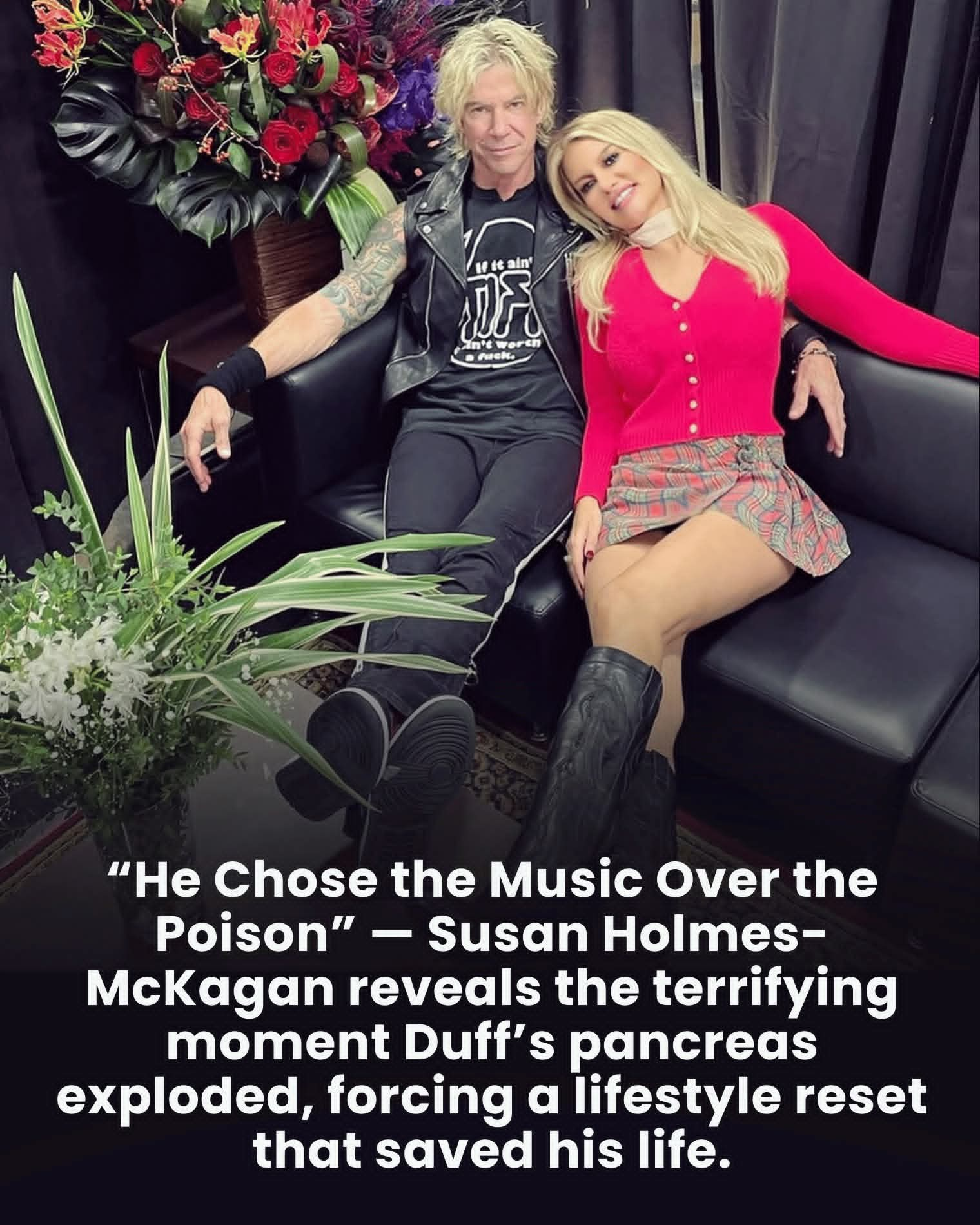
In 1994, as the chaos of grunge collided with the fading glitter of ‘80s excess, Duff McKagan lay in a Seattle hospital bed facing a truth louder than any amplifier he’d ever stood beside. His body ravaged by years of relentless touring, bottomless vodka, and the manic pace of rock superstardom had finally given him an ultimatum: stop, or die.
This wasn’t a tabloid rumor. It wasn’t another backstage scuffle or canceled show. It was acute alcohol-induced pancreatitis, a brutal diagnosis that doctors warned could end his life if he didn’t radically change immediately.
And in that sterile hospital room, far from the pyrotechnics and screaming fans, everything went quiet.
The Night the Music Nearly Stopped
By 1994, McKagan had already lived several lifetimes. As the thunderous bassist of Guns N’ Roses, he had helped propel albums like Appetite for Destruction into rock mythology. The band’s meteoric rise turned Sunset Strip misfits into global icons. Private jets replaced tour vans. Champagne flowed like water. And vodka? Vodka was breakfast.
But fame has a hidden tax.
Behind the leather and swagger, McKagan was spiraling. The endless tour cycles, internal band tensions, and a culture that glorified self-destruction pushed him to the brink. By his own later admissions, he was drinking nearly a gallon of vodka a day.
Then his pancreas ruptured.
Doctors told him bluntly: if he kept drinking, he would die. Not eventually. Soon.
For a man who had stared down riots, lawsuits, and the volatile storms inside Axl Rose’s orbit, this was different. This was biological. This was final.
Susan’s Breaking Point
Outside that hospital room stood the woman who would become his anchor: Susan Holmes-McKagan.
She has since recalled the surreal stillness of that moment. No guitars. No screaming crowds. Just machines beeping and a man at a crossroads.
It wasn’t simply about quitting alcohol. It was about choosing life over legend.
Holmes-McKagan understood something many around rock stars don’t: excess isn’t romantic when it’s lethal. She saw a future that didn’t end in tragedy, but it required a decision that would shake the very identity McKagan had built.
Would he remain the hard-partying archetype of rock mythology?
Or would he rewrite the script?
From Poison to Purpose
What followed wasn’t just rehab. It was reinvention.
McKagan didn’t merely stop drinking he rebuilt himself from the ground up. He embraced sobriety with the same intensity he once devoted to chaos. He began running miles and miles through Seattle streets. He studied martial arts. He immersed himself in reading and, astonishingly, enrolled in business classes at Seattle University.
Yes, the wild-eyed bassist of Guns N’ Roses was suddenly dissecting balance sheets and financial markets.
The transformation stunned those who only knew him as the man who swaggered through videos like Sweet Child o’ Mine with a cigarette dangling from his lips.
But McKagan wasn’t abandoning rock. He was saving it from himself.
Rewriting Rock History
Here’s the part that reshaped more than one life.
Had McKagan continued down his destructive path, the eventual reunion of Guns N’ Roses might never have happened. The historic Not in This Lifetime… Tour, which reunited key members and became one of the highest-grossing tours of all time, depended on survival literal survival.
Sobriety gave McKagan clarity. Clarity allowed reconciliation. Reconciliation made history.
When he walked back onto the stage alongside Axl Rose and Slash decades later, it wasn’t just nostalgia. It was resurrection.
The fans saw rock icons.
Few understood they were witnessing a miracle.
The Financial Prophet of Rock
In one of the most unexpected plot twists in music history, McKagan became something almost unheard of in his industry: financially literate.
After realizing how many musicians were exploited or bankrupted by bad deals, he made it his mission to understand the system. He earned a degree in finance and began advising fellow artists. Later, he even launched wealth management initiatives aimed at protecting musicians from the traps he’d narrowly escaped.
The man who once burned through money on booze and backstage debauchery was now teaching compound interest.
It wasn’t hypocrisy. It was evolution.
A Love Story in the Shadows of Chaos
Susan Holmes-McKagan has often described the transformation as radical—but real. She didn’t fall in love with a caricature of rock excess. She fell in love with a man capable of change.
Together, they built a family something that once seemed impossible during the blur of world tours and addiction.
For McKagan, fatherhood became another anchor. It redefined what strength meant. It wasn’t about smashing hotel rooms or surviving on two hours of sleep. It was about presence. Responsibility. Longevity.
The Choice That Echoes
Rock history is littered with “what ifs.” What if this guitarist hadn’t overdosed? What if that singer hadn’t crashed their car? Entire eras have been shaped by premature endings.
In 1994, Duff McKagan nearly became another cautionary tale.
Instead, he became a counter-narrative.
The silence of that hospital room did what no stadium roar could: it forced him to listen.
To his body. To his future. To the people who loved him.
And when he chose music over poison, he didn’t just save his own life. He altered the trajectory of one of the most volatile bands in rock history.
Today, when he straps on his bass and steps onto a stage in front of tens of thousands, the sound feels different. It’s still thunderous. Still electric.
But beneath the distortion lies something far more powerful than volume.
It’s survival.
It’s a man who stared death in the face and decided the encore wasn’t over.
And somewhere, in the memory of that quiet hospital room, the choice still echoes proof that sometimes the loudest moment in rock history happens in absolute silence.
Leave a Reply