
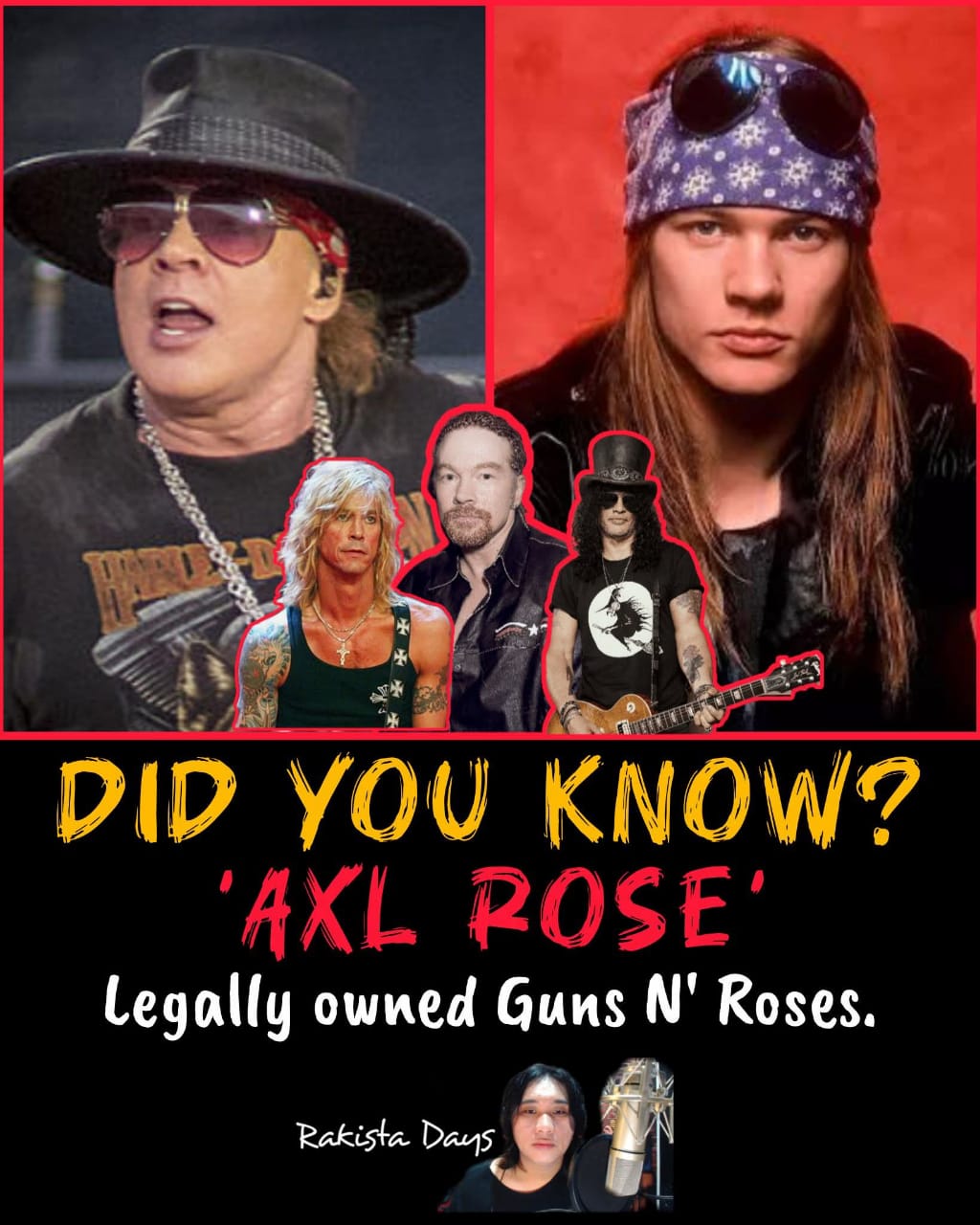
It’s one of the most explosive twists in rock history and for decades, many fans never saw it coming.
Behind the screaming guitars, stadium tours, and legendary feuds, a quiet legal move in 1990 changed Guns N’ Roses forever. While the world was watching the band dominate MTV and shatter attendance records, Axl Rose made a decision that would cement his power for life.
He secured full legal control of the Guns N’ Roses name.
Yes 100%.
And here’s the bombshell: Slash, Duff McKagan, and the other classic-era members never owned the name of the band they helped make famous.
Let that sink in.
The Power Move That Changed Everything
By 1990, Guns N’ Roses were already rock royalty. Appetite for Destruction had exploded. “Sweet Child O’ Mine” was everywhere. “Welcome to the Jungle” became a cultural battle cry. The band was unstoppable and volatile.
Behind the scenes, tensions were rising. Creative differences. Substance issues. Management conflicts. The band was a powder keg waiting to blow.
That’s when Axl reportedly made his move.
During contract negotiations tied to the massive Use Your Illusion era, Axl leveraged his position and insisted on ownership rights to the Guns N’ Roses name. The agreement gave him control over the brand legally and permanently.
It wasn’t just symbolic power.
It was absolute authority.
From that point forward, Axl Rose became the legal gatekeeper of Guns N’ Roses.
Slash and Duff: Rock Legends Without the Name
Slash’s riffs defined the band’s sound. Duff’s basslines anchored the chaos. Together, they were the heartbeat of Guns N’ Roses.
But ownership? That was a different story.
While Slash and Duff earned and continue to earn substantial royalties from record sales, publishing, touring, and merchandise, they did not own the Guns N’ Roses trademark.
That distinction matters.
Owning music rights means you get paid.
Owning the band name means you control the future.
And that future was in Axl’s hands.
The Fallout That Shocked Rock
By the mid-1990s, the cracks became fractures.
Slash left in 1996.
Duff followed in 1997.
The classic lineup was gone.
Yet the name Guns N’ Roses lived on because legally, it belonged to Axl.
In 2001, fans were stunned when a completely new lineup took the stage under the Guns N’ Roses banner at Rock in Rio. No Slash. No Duff. No Izzy. Just Axl and a new cast of musicians.
Many hardcore fans felt betrayed.
“How can this be Guns N’ Roses without Slash?” they asked.
Legally? It could because Axl owned the name.
That single decision in 1990 made it possible for Axl to rebuild, rebrand, and relaunch the band entirely on his terms.
The $100 Million Reunion Twist
Fast forward to 2016.
After nearly two decades of public tension, lawsuits, and icy interviews, the impossible happened.
Slash and Duff returned.
The “Not In This Lifetime” tour exploded across the globe, becoming one of the highest-grossing tours in rock history reportedly earning over $500 million.
Fans celebrated what felt like a miracle.
But here’s the untold layer: their return didn’t change ownership.
Axl still held the name.
The reunion was a partnership not a power shift.
That legal structure reportedly remained intact, meaning Guns N’ Roses continued operating under Axl’s control, even with Slash and Duff back in the fold.
Was It Genius… or Ruthless?
Reactions to the revelation are sharply divided.
Some see it as a brilliant business move. Axl protected the brand during a chaotic era. Without centralized ownership, Guns N’ Roses might have dissolved into endless legal disputes and splinter bands battling over the name.
Others call it cold-blooded.
Critics argue that a band built on chemistry, sweat, and shared rebellion should have shared ownership. They say Slash and Duff helped build the empire — and should have owned a piece of the crown.
But in the music industry, sentiment doesn’t sign contracts.
Paperwork does.
The Business of Rock ‘n’ Roll
This isn’t the first time a band’s name became the ultimate weapon.
From The Beach Boys to Queensrÿche, ownership battles have torn apart legendary groups. Control of the trademark often determines who tours, who records, and who cashes in.
Axl Rose simply made sure there would be no ambiguity.
He locked it down.
And that foresight gave him something few rock frontmen ever achieve: total brand authority.
Why Fans Are Just Learning This Now
For years, the focus stayed on the drama — the fights, the walk-offs, the infamous onstage meltdowns.
The legal fine print rarely made headlines.
But as more fans dig into music industry history and business structures, the truth has resurfaced with fresh shock value.
The wildest band in the world was, behind the scenes, controlled by one man.
And that man made his move at the height of their fame.
What This Means for the Future
As Guns N’ Roses continue touring into the 2020s, one thing remains clear:
The name is secure.
Any lineup change, any creative shift, any future album all roads still run through Axl Rose.
Slash may deliver the iconic solos.
Duff may command the low end.
But the legal signature that keeps Guns N’ Roses alive belongs to Axl.
And it has since 1990.
The Final Word
Love him or criticize him, Axl Rose didn’t just scream his way into rock history.
He negotiated his way into it.
In an industry where bands implode over ego and money, Axl ensured that no matter who stayed or left, Guns N’ Roses would survive under his control.
Slash and Duff helped build the legend.
But Axl owned the name.
And in rock ‘n’ roll, that changes everything.
Leave a Reply