
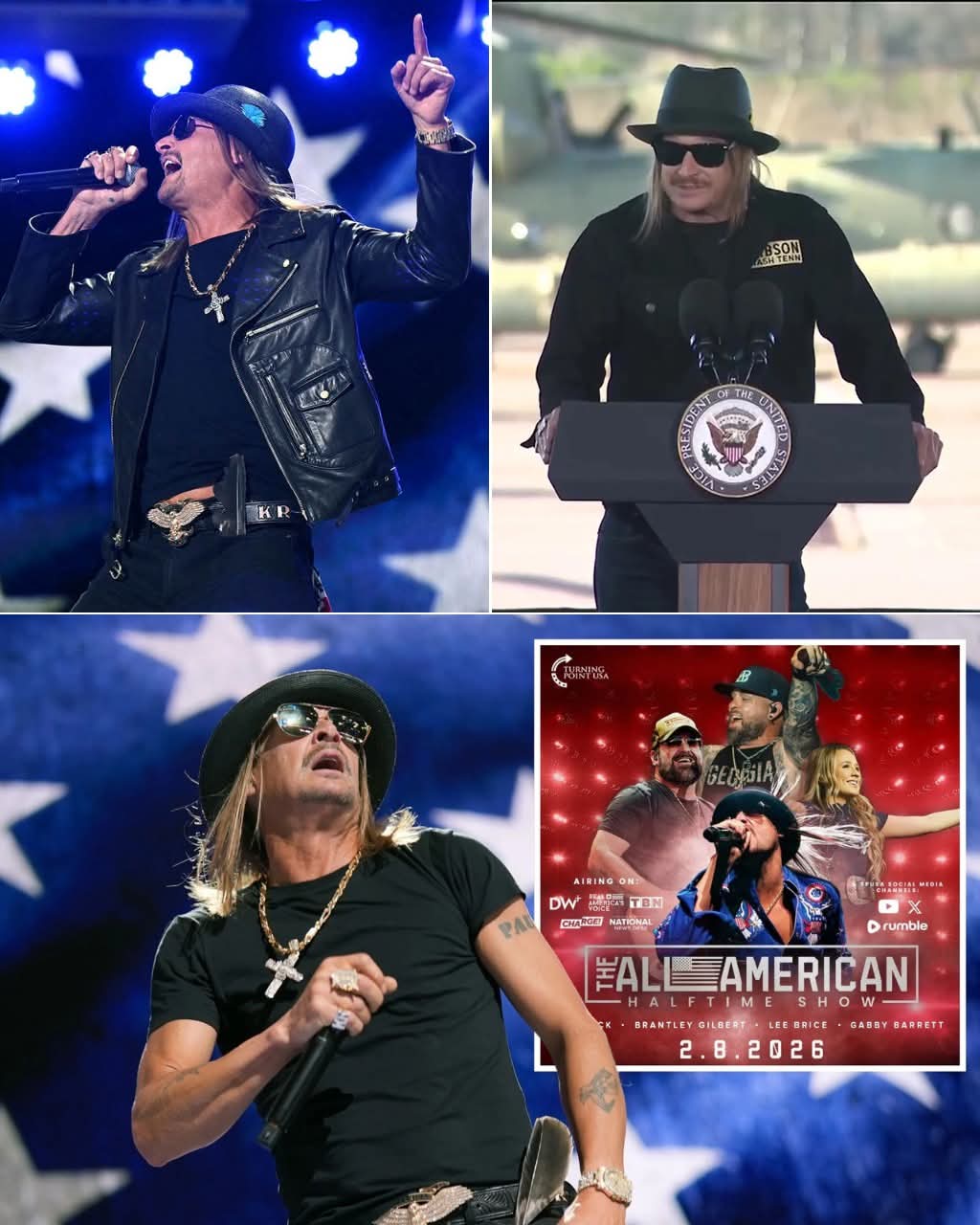
Just hours before Super Bowl madness swallowed the country whole before the tailgates, the fireworks, the halftime hype, and the billion-dollar commercials Kid Rock stepped into the spotlight and lit a match. One sentence. One unapologetic line. And suddenly, the biggest night in sports had an unexpected pregame controversy.
“Turn off Bad Bunny if you’re proud to be American.”
The timing couldn’t have been louder. With the stadium buzzing, fans counting down to kickoff, and social media already on fire, Kid Rock didn’t whisper his message he dropped it like a thunderclap. Within minutes, his words were everywhere. Screenshots. Reaction videos. Furious think pieces. Cheering supporters. Outrage critics. The Super Bowl hadn’t even started yet, and the culture clash was already in full overtime.
This wasn’t a slip of the tongue. It wasn’t a joke. And it certainly wasn’t accidental.
Kid Rock knew exactly what he was doing.
A Statement, Not a Soundbite
According to Rock, the alternative halftime-style event he’s tied to wasn’t meant to appeal to everyone. In fact, that was the entire point. This wasn’t about chasing trends, pleasing critics, or bowing to pop culture’s shifting winds. This was about his people.
The people who love football.
The people who love America.
The people who love loud guitars, simple hooks, and unapologetic patriotism.
And yes the people who love Jesus.
No filters. No apologies.
That phrase might as well be Kid Rock’s personal constitution. While the NFL continues leaning into global pop stars, crossover appeal, and international flavor, Rock planted his boots firmly in the dirt and said, this isn’t for everyone and it’s not supposed to be.
The Super Bowl as a Cultural Battlefield
The Super Bowl isn’t just a game anymore. It’s America’s biggest cultural mirror and Kid Rock smashed it right down the middle.
On one side: glossy pop spectacle, global superstars, multilingual hits, and carefully curated inclusivity.
On the other: red-white-and-blue pride, rock riffs, faith-forward messaging, and a deep attachment to traditional American identity.
By name-dropping Bad Bunny one of the most streamed artists on the planet and a symbol of modern, globalized pop culture Rock turned an already simmering debate into an open confrontation.
To his supporters, it sounded like someone finally saying what they’ve been thinking for years.
To his critics, it sounded like gatekeeping, exclusion, and unnecessary provocation.
And to the internet? It sounded like blood in the water.
The Reaction Was Instant and Explosive
Within minutes, hashtags exploded. Comment sections turned into battlegrounds. Fans praised Rock for “standing his ground” and “speaking for real Americans.” Others accused him of ignorance, intolerance, and dragging faith and patriotism into a music fight that didn’t need them.
Some called it brave.
Some called it reckless.
Some called it predictable.
But nobody ignored it.
That’s the part that matters.
In an era where controversy often feels manufactured, this felt raw. Unpolished. Old-school. Kid Rock didn’t issue a press release. He didn’t soften the message. He didn’t walk it back. He said it, stood by it, and let the chaos roll.
Why This Hit So Hard
The Super Bowl is supposed to be neutral ground one night where everyone watches the same thing, cheers for the same spectacle, and argues only about commercials. Kid Rock shattered that illusion.
By tying music taste to national pride, he crossed into dangerous, emotional territory. Music isn’t just entertainment anymore it’s identity. Culture. Belonging. And when someone suggests that one sound represents “real America” more than another, sparks are guaranteed to fly.
But for Rock, that friction is the fuel.
He’s built an entire career on refusing to blend in. From his genre-smashing sound to his political stances, he’s never chased consensus. This moment wasn’t a rebrand it was a reminder.
Love Him or Hate Him, He Won the Moment
Here’s the uncomfortable truth for critics: Kid Rock got exactly what he wanted.
He didn’t hijack the Super Bowl with a performance he hijacked it with a sentence.
While millions were debating halftime rumors, commercials, and betting odds, the conversation suddenly shifted. Faith. Patriotism. Who the NFL is for. Who America is for. Who gets the spotlight — and who feels left out.
That’s power.
Whether you see him as a cultural warrior or a provocateur stuck in the past, Kid Rock forced a national conversation at the loudest possible moment. And in today’s attention economy, that’s a victory few artists can still pull off.
The Bigger Question No One Can Ignore
Kid Rock’s line wasn’t really about Bad Bunny.
It was about ownership.
About identity.
About who feels seen and who feels erased on America’s biggest stage.
As the Super Bowl kicked off and the lights exploded across the field, one thing was already clear: the game hadn’t even started, but the culture war was already raging.
And Kid Rock?
He wasn’t backing down.
Not now.
Not ever.
Leave a Reply