
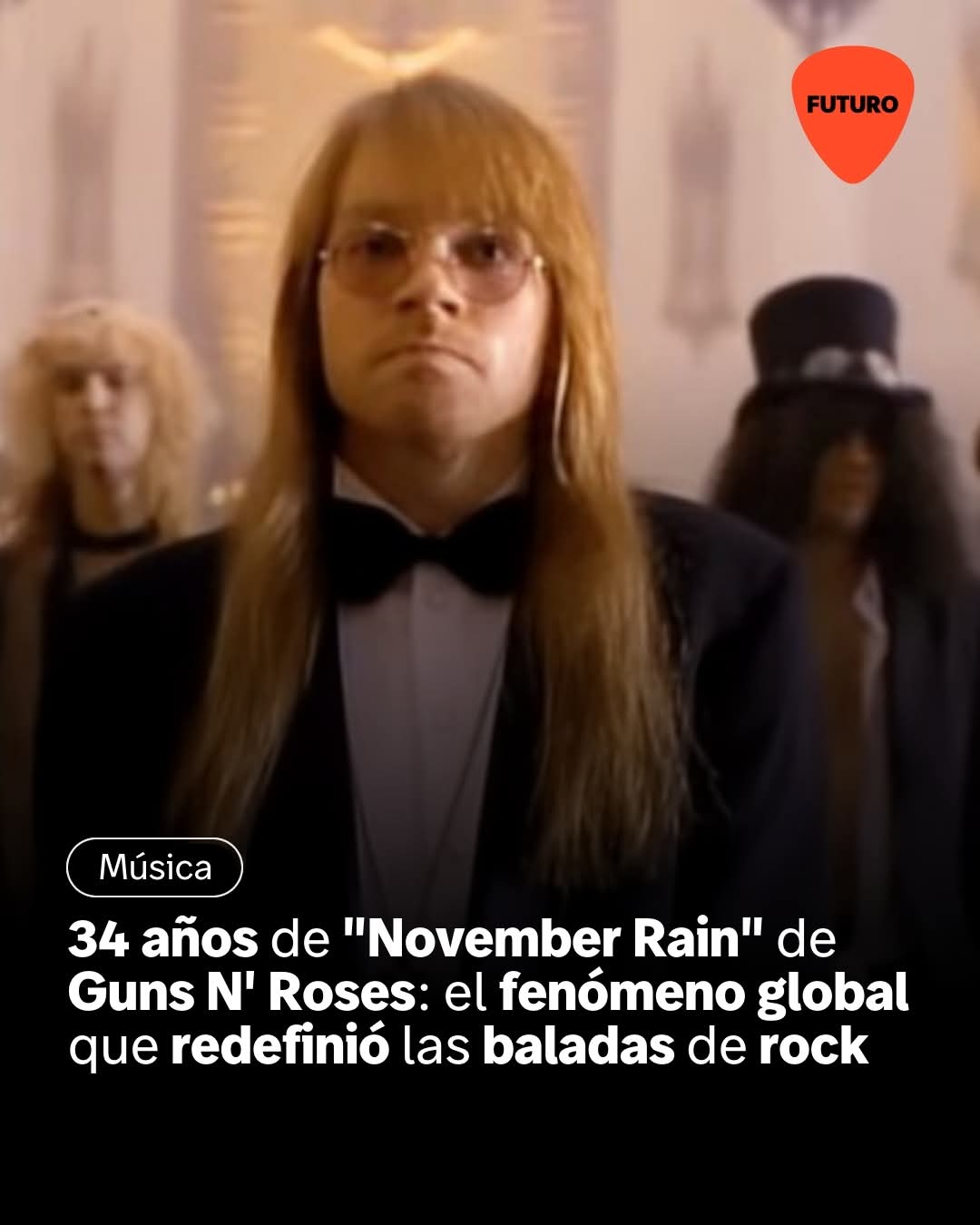
In 1991, at a time when flannel shirts and stripped-down angst were beginning to dominate the airwaves, one band dared to go bigger. Much bigger. When November Rain erupted onto the global stage 34 years ago, it didn’t just climb the charts it detonated expectations. Rock ballads would never sound the same again.
Released as part of Use Your Illusion I, the nearly nine-minute epic was more than a song. It was a cinematic event, an orchestral storm wrapped in heartbreak, grandeur, and raw nerve. At a time when radio favored tight, four-minute hits, Guns N’ Roses shattered the mold with a sweeping composition that felt closer to a film score than a traditional hard rock single.
And the world couldn’t look away.
The Ballad That Refused to Play by the Rules
From its delicate piano intro to its explosive guitar crescendos, “November Rain” unfolds like a tragic love story told in acts. The song opens in vulnerability a lonely piano, penned and performed by Axl Rose, who had reportedly been crafting the piece for nearly a decade before its release. But what begins in fragility soon expands into full orchestral drama, complete with sweeping strings and thunderous percussion.
This wasn’t just ambition. It was audacity.
In an era when hard rock was either snarling or stripped down, Guns N’ Roses leaned into grandeur. They layered classical-inspired arrangements over arena-sized emotion. They stretched the runtime past what program directors considered “safe.” They bet that audiences would sit still for nine minutes of evolving tension and release.
They were right.
November Rain” didn’t just become a hit it became a global phenomenon. It stormed charts worldwide, dominated MTV rotation, and cemented itself as one of the most iconic rock ballads of all time.
Slash’s Solo: A Guitar Moment for the Ages
No discussion of “November Rain” is complete without the solo that solo.
When Slash steps forward in the song’s climactic sections, time seems to freeze. His guitar doesn’t simply accompany the orchestra it slices through it, cries over it, and ultimately transcends it. The final extended solo, particularly as depicted in the legendary music video, became one of the most unforgettable images of 90s rock.
Top hat. Wind-swept desert chapel. Guitar raised against a gray sky.
It wasn’t subtle. It wasn’t minimal.
It was mythic.
For a generation of aspiring guitarists, that solo was a declaration: emotion and technicality could coexist. Drama was not the enemy of authenticity. And rock could still feel dangerous not because it was reckless, but because it dared to feel deeply and loudly.
A Music Video That Changed the Game
If the song was cinematic, the music video was pure Hollywood spectacle.
At a time when MTV still ruled pop culture, Guns N’ Roses delivered a short film rather than a promotional clip. With a budget rumored to be among the highest ever for a music video at the time, “November Rain” played out like a tragic romance complete with lavish wedding scenes, shocking twists, and operatic grief.
It wasn’t just watched. It was experienced.
The video dominated airwaves and later became one of the first rock videos from the 90s to surpass a billion views on YouTube decades later proof that its emotional punch transcends eras. New generations, born long after the original release, continue to discover its grandeur and fall under its spell.
Vulnerability Meets Grandiosity
At its core, “November Rain” works because of its emotional tension. The lyrics wrestle with love’s fragility the fear that even the most intense connection can dissolve. Axl Rose’s vocal performance walks a razor’s edge between tenderness and theatrical explosion. He whispers, he pleads, he roars.
And in doing so, he redefined what a hard rock frontman could sound like on a ballad.
This wasn’t the power ballad formula perfected by 80s hair metal bands. It was darker. More layered. More symphonic. Guns N’ Roses didn’t soften their edge they expanded it. They proved that vulnerability didn’t require abandoning scale. In fact, they suggested the opposite: that the biggest emotions demand the biggest canvases.
Breaking Radio And Winning Anyway
Nine minutes. Orchestras. Multiple guitar solos. A slow build that takes its time.
By industry standards, “November Rain” should have struggled. Instead, it thrived. Radio stations played edited versions, but fans sought out the full experience. Concert performances turned into communal catharsis, with stadiums swaying under lighters and, later, phone lights.
It broke the unwritten rules of commercial rock and was rewarded for it.
In doing so, Guns N’ Roses redefined what mainstream audiences would accept. They expanded the boundaries of hard rock, proving that ambition could coexist with mass appeal. “November Rain” became a benchmark the gold standard for epic ballads in massive rock.
A Cultural Landmark That Won’t Fade
Thirty-four years later, the song continues to accumulate streams, rack up views, and appear on “greatest of all time” lists. It has outlived trends, survived lineup changes, and endured the shifting tides of the music industry.
Why?
Because it isn’t just a song. It’s an experience.
“November Rain” captures a rare moment when a band at its commercial peak decided to risk excess rather than retreat into safety. It embodies the spirit of creative fearlessness the willingness to push past format and into something monumental.
And it reminds us that rock, at its best, is not about fitting in.
It’s about building cathedrals of sound in the middle of a storm.
The Standard of Ambition
More than a ballad, “November Rain” became a measuring stick. Whenever a rock band attempts something grand, orchestral, or emotionally sprawling, comparisons inevitably surface. The shadow of Guns N’ Roses’ masterpiece looms large.
That’s the mark of a cultural landmark.
Thirty-four years ago, a nearly nine-minute epic dared to challenge radio, redefine hard rock, and marry vulnerability with bombast. In doing so, it forever changed how we understand the rock ballad.
And every time those opening piano notes fall like distant thunder, one thing becomes clear:
The rain never really stopped.
Leave a Reply