
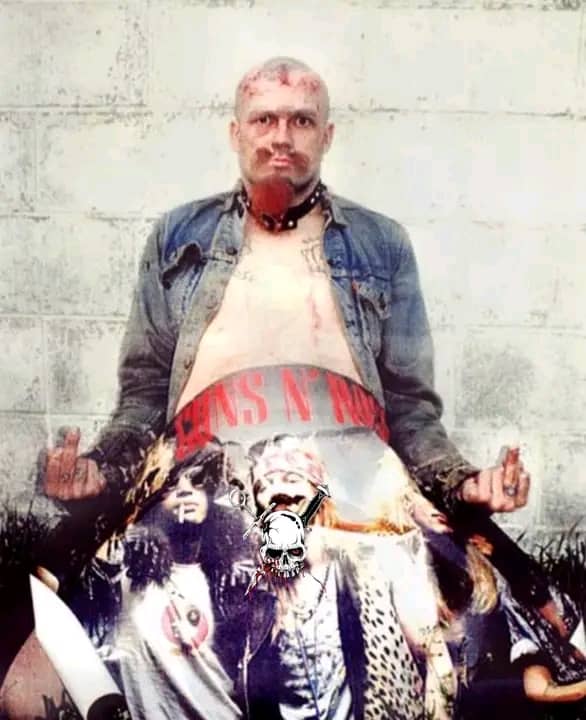
Rock history is full of wild moments smashed guitars, onstage riots, backstage brawls. But few images have sparked as much outrage, confusion, and twisted fascination as the notorious late-’80s photo of GG Allin standing in front of a Guns N’ Roses poster in a way that left absolutely nothing to the imagination.
For some fans, it was pure shock value.
For others, it was a calculated declaration of war.
And for those who know the story behind it? It was the final chapter in a bizarre love-turned-hate saga that perfectly captured the collision between underground chaos and mainstream superstardom.
From Obsession to Obsession’s End
Back in 1988, before bitterness fully consumed him, GG Allin and his brother Merle Allin were reportedly obsessed with Guns N’ Roses. At the time, the L.A. band was exploding worldwide thanks to their debut album Appetite for Destruction, a record that redefined hard rock and sent shockwaves through the music industry.
Songs like Welcome to the Jungle weren’t just hits they were cultural detonations. The raw attitude, sleaze, and danger felt authentic. Even punks who hated corporate rock couldn’t deny the energy.
There’s even a now-legendary 1988 photo of GG standing in front of a “Welcome to the Jungle” poster, looking almost like a fan. It’s one of the strangest “what if” images in rock history the underground’s most volatile figure appearing, at least briefly, aligned with the biggest rising band on the planet.
But that alignment wouldn’t last.
Prison Changed Everything
When GG Allin went to prison, something shifted. By the time he got out, the man who once seemed intrigued by Guns N’ Roses had transformed into someone who despised nearly everyone and especially bands he felt had “sold out.”
And by then, Guns N’ Roses weren’t just rising stars.
They were giants.
Stadium tours. MTV dominance. Multi-platinum records. Global fame.
To GG, that success wasn’t admirable it was betrayal.
He believed the underground should stay underground. Chaos should remain chaotic. And once a band crossed into mainstream acceptance, in his eyes, they were no longer dangerous they were compromised.
The Photo That Became a Statement
That’s when the infamous image emerged.
In the photo, GG poses in front of a Guns N’ Roses poster in a deliberately obscene and confrontational manner. It wasn’t subtle. It wasn’t artistic. It wasn’t accidental.
It was an attack.
Fans who saw it at the time were stunned. Was it jealousy? Was it parody? Was it a publicity stunt? Or was it simply GG doing what he always did escalating provocation to its most extreme form?
The truth is, it was probably all of the above.
GG Allin thrived on outrage. His concerts were infamous for violence, bodily fluids, and total unpredictability. He didn’t just want attention he wanted disgust. He wanted confrontation. He wanted to force people to react.
And targeting one of the biggest rock bands in the world guaranteed exactly that.
Mainstream vs. Mayhem
The late ’80s created a strange dynamic in rock music. On one end, you had polished stadium acts dominating MTV. On the other, you had underground artists fighting to remain raw and unfiltered.
Guns N’ Roses were interesting because they straddled both worlds. They had the grit of street rock but the reach of global superstars. To many fans, they were authentic rebels who just happened to succeed.
But to GG, success itself was suspicious.
In interviews and in his own writings including references to his so-called “mission” he made it clear he believed in total destruction of the system, not participation in it. He wasn’t interested in platinum records or arena tours. He wanted shock, chaos, and cultural collapse.
So that photo wasn’t just lewd behavior.
It was symbolic warfare.
A Twisted Mirror
What makes the whole episode so fascinating is that, in a strange way, GG and Guns N’ Roses shared some DNA.
Both thrived on danger.
Both terrified parents.
Both built reputations on unpredictability.
But where one channeled chaos into chart-topping anthems, the other embraced total self-destruction.
Guns N’ Roses transformed rebellion into massive commercial success. GG Allin turned rebellion inward, burning every bridge in sight.
The infamous image feels like a moment where those two paths violently collided underground extremism versus mainstream dominance.
Shock as Currency
By the time the photo circulated among fans and zines, GG had already cemented himself as punk’s ultimate outlaw. But attaching himself even in opposition to a band as massive as Guns N’ Roses amplified his notoriety.
It was a calculated risk.
Love them or hate them, mentioning Guns N’ Roses guaranteed attention. And GG understood attention better than most.
He may have despised mainstream rock, but he knew how to use it.
The Legacy of a Moment
Today, that photo lives on in rock folklore. It’s passed around online, debated in forums, and referenced in documentaries about underground music culture.
Some see it as juvenile.
Some see it as fearless.
Some see it as tragic.
But nearly everyone agrees on one thing:
It perfectly captures the late-’80s tension between commercial success and underground purity.
GG Allin didn’t just reject fame he attacked it. And by targeting one of the era’s most explosive bands, he ensured the gesture would never be forgotten.
What It Really Meant
Was it about Guns N’ Roses specifically?
Or was it about what they represented?
Perhaps GG wasn’t attacking a band he was attacking the idea that rebellion could become profitable. That danger could be packaged. That chaos could be marketed.
In his worldview, once rebellion becomes mainstream, it stops being rebellion.
Whether you agree with him or not, the image forces a question that still resonates in today’s music industry:
Can a band stay dangerous once it becomes successful?
Rock History’s Most Uncomfortable Snapshot
The infamous photo isn’t just shock art it’s a time capsule.
It reminds us that the late ’80s were more than hairspray and MTV glam. Beneath the surface, there was a cultural tug-of-war happening between chaos and commerce.
And for one brief, controversial moment, GG Allin made sure that war had a face.
Disturbing? Absolutely.
Meaningless? Not even close.
Because sometimes, the ugliest images in rock history tell the most revealing stories.
And this one still refuses to be ignored.
Leave a Reply