
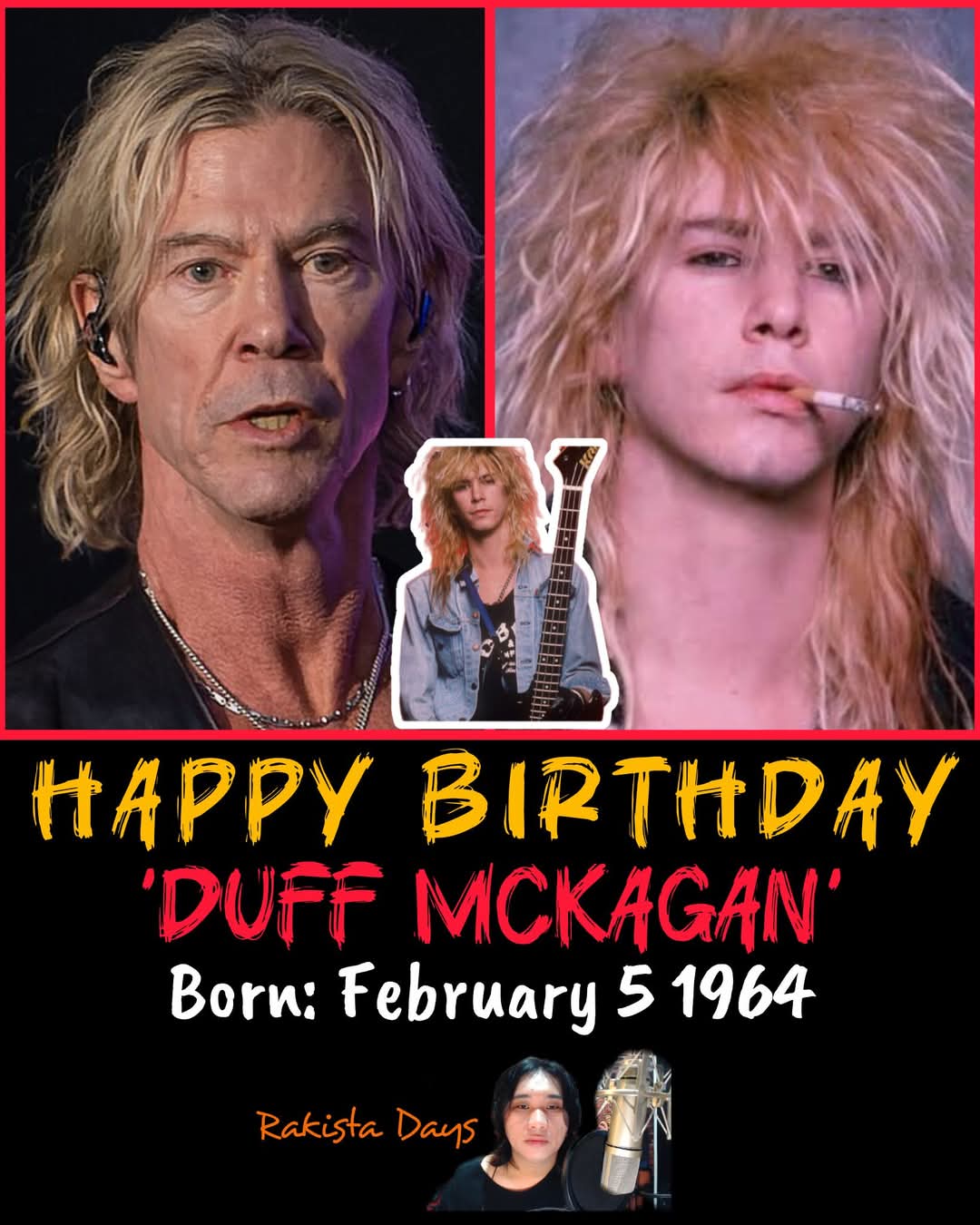
When Guns N’ Roses detonated onto the world stage in the late 1980s, the headlines screamed about chaos, danger, and excess. Axl Rose’s banshee howl. Slash’s top hat and molten guitar solos. The scandals, the riots, the legends. But buried beneath the noise literally and historically was the man who made it all move. Today, as Duff McKagan turns 62, one truth hits harder than ever: without Duff’s bass, Appetite for Destruction doesn’t just sound different it doesn’t become immortal.
Duff McKagan was never the loudest member of Guns N’ Roses. He didn’t demand the spotlight. He didn’t chase headlines. Instead, he did something far more dangerous and enduring: he anchored the most volatile rock band of its era with a groove so relentless it still rattles speakers nearly four decades later.
Released in 1987, Appetite for Destruction wasn’t just an album it was a street fight pressed onto vinyl. And Duff’s bass wasn’t decoration. It was the spine. The pulse. The engine that kept the chaos from collapsing under its own weight.
Listen closely to “Welcome to the Jungle.” That slithering bass line doesn’t follow the guitars it stalks them. It moves with punk aggression but swings with a funk-rooted bounce that gave Guns N’ Roses their impossible-to-copy swagger. While other bands of the era chased glam excess, Duff dragged punk grit and street realism straight into hard rock’s bloodstream.
And that wasn’t accidental.
Before Guns N’ Roses, Duff was a Seattle punk kid. The Sex Pistols, The Clash, and raw underground rebellion shaped his musical DNA long before Hollywood Sunset Strip dreams entered the picture. When he landed in Los Angeles, he didn’t abandon that edge he weaponized it. That punk sensibility fused with Slash’s blues, Izzy Stradlin’s Stones-like rhythm guitar, and Axl’s feral vocals created a sound that felt dangerous because it was.
On “Sweet Child O’ Mine,” one of the most overplayed songs in rock history, Duff’s bass quietly does the impossible: it grounds a song that could’ve floated away on sentimentality. His bass line is warm, melodic, and human the emotional floor beneath one of rock’s most iconic guitar intros. Without it, the song loses its heartbeat.
But Appetite wasn’t built on tenderness alone. Tracks like “It’s So Easy” and “Nightrain” are driven by Duff’s aggressive, almost confrontational bass tone. He didn’t just play notes he attacked them. Every thump felt like boots hitting pavement at 2 a.m., every slide reeked of alleyway danger and whiskey-soaked bravado.
And here’s the wild part: Duff wasn’t even trying to be flashy.
In an era obsessed with speed, solos, and spectacle, McKagan focused on feel. He understood something many players never learn — groove outlives technique. That understanding made him irreplaceable. When Guns N’ Roses imploded in the 1990s, countless lineup changes followed. Guitarists came and went. Drummers rotated. But when Duff returned for the Not In This Lifetime… Tour, the band suddenly sounded right again. Fans felt it instantly.
That tour didn’t just break records it rewrote them. Night after night, Duff stood stage left, bass slung low, locking the band together like a steel cable. No overplaying. No ego. Just authority. At 50-plus years old, he played with the same hunger that defined Appetite for Destruction proving that real groove doesn’t age.
Offstage, Duff’s story is just as shocking.
After surviving addiction, pancreatitis, and a near-death health crisis in the 1990s, McKagan rebuilt himself from the ground up. He went back to school. Studied finance. Became a bestselling author. A sobriety advocate. A thinker in a band once defined purely by recklessness. While rock history is littered with cautionary tales, Duff became something rarer: a survivor who evolved without losing credibility.
And that evolution only deepened his legend.
Today, bass players across genres punk, hard rock, metal, even pop cite Duff McKagan as a blueprint. Not because he was the fastest. Not because he was the loudest. But because he made bands feel dangerous. Because he understood that the bass isn’t there to show off it’s there to make people move, sweat, and believe.
At 62, Duff McKagan stands as living proof that rock history isn’t just written by frontmen and guitar gods. Sometimes, it’s built from the bottom up one unforgettable groove at a time.
Appetite for Destruction has sold over 30 million copies. It’s been streamed billions of times. It’s studied, celebrated, and endlessly replayed. And every time those opening notes hit, Duff’s bass is right there still shaking walls, still rattling nerves, still reminding the world why Guns N’ Roses didn’t just arrive… they conquered.
Happy 62nd Birthday, Duff McKagan.
The backbone of a revolution. The groove that built rock history.
Leave a Reply