
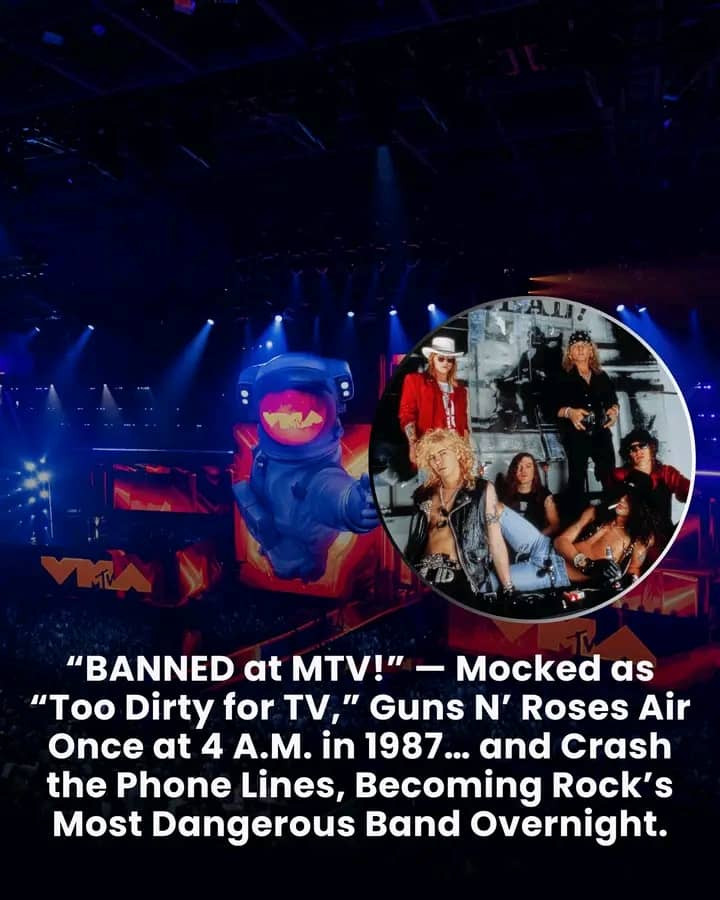
In the summer of 1987, Guns N’ Roses weren’t supposed to happen.
They were too raw. Too ugly. Too loud. Too violent. Too real.
At least, that’s what MTV executives thought.
Before Appetite for Destruction would go on to become the best-selling debut album in rock history, before “Sweet Child O’ Mine” ruled the world, before Axl Rose became both a genius and a lightning rod for controversy, Guns N’ Roses were effectively banned from television—dismissed as a sleazy L.A. club band that didn’t belong on America’s most powerful music platform.
And then MTV made one tiny, careless mistake.
They aired “Welcome to the Jungle” onceat 4 a.m.
What happened next terrified the network.
Too Dirty for TV
When Geffen Records first submitted the “Welcome to the Jungle” video to MTV, the response was brutal.
Executives reportedly recoiled at the sight of Axl Rose screaming into the camera, Slash lurking in the shadows like a street predator, and the band’s grimy, dangerous aesthetic that looked nothing like the polished pop-metal MTV was comfortable pushing at the time.
This was the era of pretty boys and peroxide smiles. Guns N’ Roses looked like they slept in alleyways.
The verdict was swift: too aggressive, too dark, too ugly.
MTV refused to put the video into regular rotation. Some insiders later recalled it being laughed off as “unmarketable.” Others called it “too dirty for TV.”
In short, Guns N’ Roses were dead on arrival—at least on television.
The 4 A.M. Gamble
But Geffen Records wouldn’t let it die quietly.
Desperate to get any exposure, the label pressured MTV into a compromise: one late-night airing, buried so deep in the schedule that no one important would notice if it failed.
So MTV slipped “Welcome to the Jungle” into the rotation at 4 a.m., a time slot reserved for insomniacs, night-shift workers, and nobody else.
Executives expected silence.
Instead, chaos erupted.
The Phone Lines Explode
Within minutes of the video airing, MTV’s request lines lit up like a Christmas tree.
Viewers were calling nonstop, demanding to know who the hell that band was and why the video wasn’t playing again.
The reaction stunned everyone.
This wasn’t a mild response—it was a frenzy.
People weren’t just asking for the video to be replayed. They were obsessed. MTV staff later admitted they’d never seen anything like it from a single, off-hours airing.
The band MTV had written off as “too dirty” had just hijacked the network while executives were asleep.
Panic at MTV Headquarters
By morning, confusion turned into concern.
Why were people still calling? Why wouldn’t the requests stop? Who were these guys?
MTV executives scrambled to rewatch the video—not through the lens of fear, but curiosity. This time, they saw what millions of viewers instantly recognized: danger, authenticity, and a level of raw intensity rock music had been missing.
“Welcome to the Jungle” didn’t feel manufactured. It felt real. It felt like Los Angeles after midnight. It felt like a warning.
MTV hadn’t just misjudged Guns N’ Roses.
They’d nearly missed the next cultural earthquake.
From Banned to Unstoppable
Once MTV added the video into regular rotation, there was no stopping it.
“Welcome to the Jungle” became a phenomenon. Viewers were glued to the screen, mesmerized by Axl Rose’s feral charisma and Slash’s menacing cool. The band looked like they could explode at any moment—and that unpredictability made them irresistible.
Appetite for Destruction began to climb the charts, slowly at first, then violently.
What started as a single 4 a.m. experiment turned into a full-scale takeover.
Within a year, Guns N’ Roses were the most talked-about band in the world.
Why MTV Was So Afraid
The truth is, MTV didn’t just fear the band’s image—they feared what Guns N’ Roses represented.
This wasn’t party rock. This wasn’t escapism. This was chaos, addiction, street violence, and emotional breakdowns blasted through Marshall stacks.
Axl Rose wasn’t smiling for the camera. He was daring it to look away.
Slash wasn’t posing. He was stalking.
Guns N’ Roses forced MTV—and the industry—to confront something uncomfortable: rock music wasn’t supposed to be safe
Overnight Legends, Forever Dangerous
That single, accidental airing didn’t just launch a career—it rewrote the rules.
Guns N’ Roses proved that you couldn’t manufacture authenticity. You couldn’t sanitize rebellion. And you couldn’t predict what audiences would connect with when something felt real.
MTV tried to bury them.
Instead, they created a monster.
By the time “Sweet Child O’ Mine” hit No. 1, it was already too late. Guns N’ Roses had taken control, dragging mainstream rock back into the gutter—and making it thrilling again.
The Lesson MTV Learned the Hard Way
Decades later, the story still echoes through the music industry.
Every time a band is dismissed as “too risky,” “too ugly,” or “too real,” Guns N’ Roses’ 4 a.m. miracle looms large.
One spin. One mistake. One eruption.
MTV didn’t crown Guns N’ Roses.
They accidentally unleashed them.
And rock music was never the same again.
Leave a Reply