
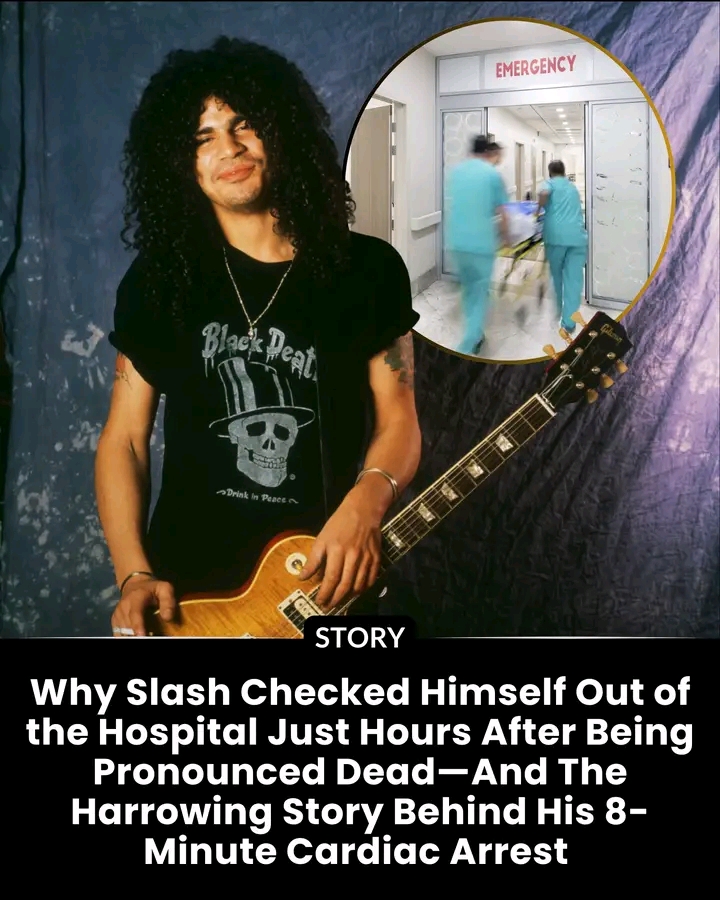
For most people, being pronounced clinically dead would be a full stop. A wake-up call. A dramatic before-and-after moment dividing life forever.
For Slash, it was just another night on the edge.
Long before stadiums, Grammys, and the immortal opening riff of “Sweet Child O’ Mine,” the Guns N’ Roses guitarist lived so hard that death briefly caught him — and let him go. What followed is one of the most jaw-dropping survival stories in rock history: an eight-minute cardiac arrest, a needle of adrenaline driven straight into his heart… and a hospital escape that defied logic, medicine, and common sense.
This isn’t myth. It’s Slash’s own chilling recollection — and it explains everything about the chaos, danger, and raw electricity that fueled Guns N’ Roses at their most lethal.
Eight Minutes Dead
It happened in the mid-1980s, before Appetite for Destruction turned the band into the most dangerous act on the planet. Slash was deep into heroin — not dabbling, not experimenting, but fully submerged. The days blurred into nights of needles, booze, and chemical roulette.
One night, his body finally said no.
Slash overdosed so severely that his heart stopped. Paramedics rushed him to the hospital, but by the time doctors took over, there was nothing resembling normal life left. His pulse was gone. His breathing had stopped.
He was clinically dead — for eight full minutes.
In emergency medicine, eight minutes without oxygen is a death sentence. Brain damage, organ failure, or permanent loss of consciousness is the best possible outcome. Doctors later admitted that what happened next shouldn’t have worked.
In a last-ditch move, a physician injected adrenaline directly into Slash’s heart — an extreme, almost cinematic procedure usually reserved for absolute no-hope scenarios.
And then, against every expectation, his heart started beating again.
Slash came back.
“I Shouldn’t Be Here”
When Slash woke up, the room didn’t feel like a miracle. It felt like an inconvenience.
He was alive, but barely. Tubes ran from his arms. IVs fed fluids into his veins. Doctors hovered, stunned that a patient who had been legally dead minutes earlier was conscious at all.
To them, he was a medical anomaly.
To Slash, it was just another interruption.
Later, he would admit that the experience didn’t scare him straight — at least not immediately. The addiction was stronger than fear, logic, or survival instinct. Death hadn’t changed him. It had merely brushed past.
And then came the part that cemented the legend.
The Hospital Escape No One Could Believe
Just hours after being revived — hours after being pronounced dead — Slash made a decision that still leaves doctors shaking their heads.
He checked himself out of the hospital.
No full recovery. No observation period. No concern for the fact that his heart had literally stopped beating earlier that same day.
According to Slash, he ripped the IVs out of his arms, ignored medical protests, signed himself out, and walked straight back to his hotel.
And then?
He kept partying.
No reflection. No dramatic vow to change. Just drugs, alcohol, and the same reckless momentum that had nearly killed him.
It’s hard to comprehend — but it perfectly captures the mindset of a band that would soon become the embodiment of excess.
Guns N’ Roses: Living Like Tomorrow Didn’t Exist
Slash’s near-death experience wasn’t an outlier. It was part of a pattern.
The early Guns N’ Roses years were not glamorous. They were brutal. The band lived in squats, survived on scraps, and chased highs that often came dangerously close to oblivion. Heroin, cocaine, alcohol — nothing was off-limits, and moderation was a foreign concept.
Slash later described that era as existing in a constant fog of self-destruction, where the idea of longevity didn’t matter. Success wasn’t guaranteed. Survival wasn’t expected.
When Appetite for Destruction exploded in 1987, it didn’t tame them — it amplified everything. Suddenly, the chaos had a soundtrack, and the world couldn’t look away.
Why He Didn’t Stop Even After Dying
The most haunting question is the simplest one: Why didn’t dying change him?
Slash has been brutally honest about it. Addiction doesn’t respond to logic. It doesn’t negotiate with fear. When you’re deep enough, even death feels abstract — like something that happens to other people.
In his mind at the time, the overdose wasn’t a warning. It was just a glitch.
That mindset followed him for years, through sold-out tours, legendary albums, and escalating substance abuse. It would take far more than a stopped heart to finally force real change.
The Wake-Up Call That Finally Stuck
Slash didn’t clean up overnight. The path to sobriety came later, after years of damage, isolation, and watching friends disappear.
But when he eventually quit drugs and alcohol, he didn’t romanticize the past. He didn’t pretend the chaos was sustainable. And he never forgot that night in the hospital — the moment when death took him and gave him back.
Today, Slash speaks about it not with pride, but with disbelief.
“I shouldn’t be here,” he’s said.
And he’s right.
Why This Story Still Shocks Fans Today
In an era when rock stars are often media-trained and cautious, Slash’s survival story feels almost unreal — a relic from a time when musicians genuinely lived like every night could be their last.
Eight minutes dead. Adrenaline to the heart. IVs ripped out. Back to partying before the sun came up.
It’s horrifying. It’s reckless. And it’s undeniably rock ’n’ roll.
But it’s also a reminder of how close we came to losing one of the most influential guitarists of all time — not to age, not to obscurity, but to a needle and a moment of silence where his heart stopped beating.
Slash lived to tell the tale.
And somehow, against all odds, he lived long enough to outgrow it.
Leave a Reply