
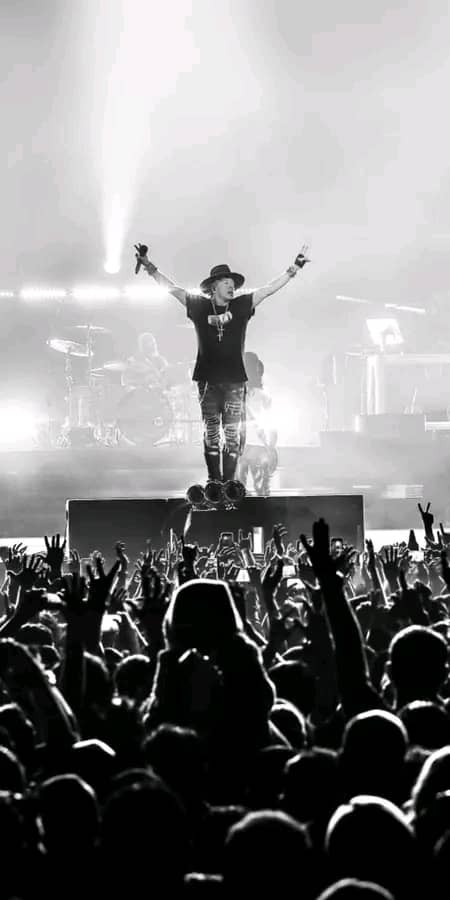
On January 4, 2018, Billboard dropped a statistic that stunned the music world—and quietly rewrote rock history.
Against all expectations, all doubts, and years of public feuds, Guns N’ Roses’ Not In This Lifetime tour officially became the fourth highest-grossing tour of all time, raking in more than $475 million.
Fourth.
Ever.
Only three tours in history stood above it:
U2 – 360º Tour ($736 million)
The Rolling Stones – A Bigger Bang ($558 million)
Coldplay – A Head Full of Dreams ($523 million)
For a band that many had written off as broken, finished, and permanently divided, the number felt almost unreal.
This wasn’t just a comeback.
It was a reckoning.
The Reunion “That Would Never Happen”
For years—decades, even—the idea of Guns N’ Roses reuniting their classic lineup was treated like a joke. Axl Rose and Slash were locked in one of rock’s most infamous feuds. Lawsuits, public insults, and years of silence made reconciliation seem impossible.
Fans learned not to hope.
Promoters stopped asking.
Journalists rolled their eyes at rumors.
And then, almost impossibly, it happened.
In 2016, Axl Rose, Slash, and Duff McKagan quietly put the past aside. No dramatic press conference. No apology tour. Just a simple announcement and a name loaded with irony:
Not In This Lifetime.
It was a wink. A challenge. A dare.
And the world answered.
Stadiums Didn’t Just Sell Out—They Exploded
From the moment tickets went on sale, demand went nuclear.
Stadiums sold out in minutes. Extra dates were added—and sold out just as fast. Fans traveled across countries and continents just to witness what many thought they’d never see: the core of Guns N’ Roses back onstage together, playing the songs that defined a generation.
This wasn’t nostalgia.
It was unfinished business.
Night after night, the band delivered marathon sets packed with Appetite for Destruction fury, Use Your Illusion grandeur, and raw, unfiltered energy. Axl—once criticized for inconsistency—showed up disciplined, focused, and vocally dangerous. Slash’s guitar cut through stadium air like it was 1987 again. Duff’s bass anchored the chaos with punk precision.
The chemistry wasn’t forced.
It was volcanic.
$475 Million—and What It Really Means
By the time Billboard confirmed the numbers in early 2018, the significance was undeniable.
More than $475 million grossed.
Millions of tickets sold.
Multiple years on the road.
And suddenly, Guns N’ Roses weren’t just a legendary band anymore.
They were one of the most commercially powerful live acts in history.
Think about that for a moment.
This wasn’t a pop act with radio rotation and viral hits. This wasn’t a band chasing trends. Guns N’ Roses hadn’t released a new album tied to the tour. They were powered almost entirely by legacy, reputation, and raw demand.
Fans didn’t come for something new.
They came for something real.
Standing Shoulder-to-Shoulder With Giants
The tours ranked above Guns N’ Roses read like a Mount Rushmore of modern music.
U2’s 360º Tour rewrote stadium production and scale, pulling in an astronomical $736 million. The Rolling Stones proved their immortality with A Bigger Bang, earning $558 million. Coldplay blended pop spectacle and global appeal on A Head Full of Dreams, reaching $523 million.
And there, right behind them?
Guns N’ Roses.
A band born from Sunset Strip chaos. A band fueled by dysfunction, brilliance, and danger. A band once considered too volatile to function—now outperforming nearly everyone else on the planet.
That contrast is what makes the achievement so staggering.
Why Fans Came Back—And Stayed
The secret wasn’t just reunion hype.
It was authenticity.
This wasn’t a polished, choreographed nostalgia act. Shows ran long. Mistakes happened. Songs stretched, evolved, and sometimes snarled their way off the rails.
And fans loved it.
Because Guns N’ Roses never pretended to be perfect. They were messy, loud, emotional, and human—exactly what modern live music often lacks.
The band didn’t sell a memory.
They delivered an experience.
From “Unreliable” to Unstoppable
Perhaps the most shocking part of the Not In This Lifetime story is how it shattered old narratives.
For years, critics painted Guns N’ Roses as unreliable. Too volatile. Too risky.
Yet the tour ran for years with consistency, professionalism, and relentless demand. Promoters made fortunes. Cities filled hotels. Fans left hoarse, exhausted, and euphoric.
Guns N’ Roses didn’t just prove they could coexist.
They proved they could dominate.
A Place Secured in History
By January 2018, the numbers spoke louder than any opinion ever could.
Fourth highest-grossing tour of all time.
Not just for rock.
Not just for their era.
For all of music.
The band that once symbolized excess, chaos, and implosion had completed one of the most disciplined, successful tours ever staged.
Irony? Maybe.
Legacy? Absolutely.
“Not In This Lifetime” Became a Lie—And a Legend
The title was supposed to be a joke.
Instead, it became a statement of defiance.
Guns N’ Roses didn’t just come back.
They reminded the world why they mattered in the first place—and why, decades later, they still do.
$475 million later, one thing is undeniable:
Rock didn’t bury Guns N’ Roses.
Guns N’ Roses buried the doubt.
Leave a Reply