
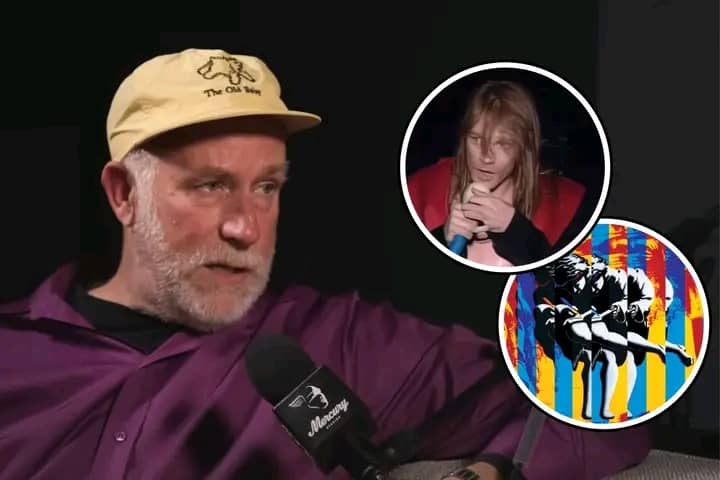
When Guns N’ Roses launched the Use Your Illusion tour in the early ’90s, it was supposed to be the loudest victory lap rock had ever seen. Stadiums. Chaos. Excess. Legends in the making. But for Roddy Bottum, the keyboardist and co-founder of Faith No More—the band tapped to open many of those dates—it became something else entirely: a shocking wake-up call, an uncomfortable education in rock-star behavior, and a moment that quietly reshaped his band’s future.
More than three decades later, Bottum isn’t mincing words.
“It was offensive,” he says now. And not in a vague, hindsight-polished way—but in the raw, lived-in sense of watching something unravel night after night from the inside.
The Tour That Was Supposed to Change Everything
On paper, it was a dream pairing. Guns N’ Roses were at their commercial peak, unleashing Use Your Illusion I and II into the world. Faith No More, fresh off the genre-smashing success of The Real Thing and “Epic,” were one of the most exciting, unpredictable bands of the era. For an opening act, it was prime real estate—millions of eyes, massive stages, and a chance to convert new fans by the tens of thousands.
Instead, what Bottum remembers most isn’t the crowds. It’s the confusion.
“We couldn’t believe what we were seeing,” he says, recalling the day-to-day reality of the tour. Shows delayed for hours. Tension behind the scenes. A sense that the spectacle had begun to eat itself.
This wasn’t just rock decadence. It was dysfunction—public, relentless, and often uncomfortable.
Waiting… and Waiting… and Waiting
By now, Use Your Illusion lore is infamous. Axl Rose’s late arrivals became legend. Entire stadiums held hostage to uncertainty. Opening bands stuck in limbo, unsure whether to play, when to play, or if the show would even happen.
For Faith No More, a band built on sharp discipline and creative friction that worked, the chaos felt alien.
Night after night, Bottum watched the same pattern repeat: hours of waiting, crowds growing restless, and an atmosphere thick with entitlement. It wasn’t glamorous. It was exhausting.
And worse—it felt wrong.
“There was a disconnect between the music and the behavior,” Bottum has suggested. “It didn’t line up with why we were doing this in the first place.”
‘Offensive’ Isn’t About Sensitivity—It’s About Power
When Bottum calls the tour “offensive,” he’s not talking about lyrics or volume or attitude. He’s talking about power—and how casually it was wielded.
To him, watching tens of thousands of fans treated as expendable time-fillers crossed a line. This wasn’t rebellion. It was indulgence. Not danger—but disregard.
Faith No More came from a different place. Their art thrived on tension, irony, and self-awareness. Guns N’ Roses, at that moment, felt untouchable—and acted like it.
For Bottum, that contrast became impossible to ignore.
A Turning Point Hidden in Plain Sight
Here’s the twist: as miserable as parts of the tour were, Bottum now calls it a turning point.
Why?
Because seeing what he didn’t want to become was just as important as seeing what he admired.
Watching the machinery of excess grind away at creativity hardened Faith No More’s resolve. They didn’t want the circus. They didn’t want the throne. They wanted control.
Shortly after, the band doubled down on experimentation, sharp left turns, and refusal to be boxed in. Albums like Angel Dust didn’t chase mass approval—they challenged it.
And in that sense, the Use Your Illusion tour didn’t derail Faith No More. It clarified them.
Two Visions of Rock Collide
The tour became a clash of philosophies.
On one side: Guns N’ Roses, raw emotion amplified to stadium scale, living dangerously close to implosion.
On the other: Faith No More, cerebral, confrontational, allergic to ego calcification.
Bottum didn’t hate Guns N’ Roses. He watched them. Studied them. And ultimately decided that wasn’t the road he wanted to walk.
Sometimes the most important lessons don’t come from mentors—but from warnings.
History Has a Way of Vindicating Honesty
Today, the Use Your Illusion era is remembered with awe—and a wince. The music still towers. But the stories? They’re cautionary tales.
Bottum’s reflections feel less like bitterness and more like truth aging into clarity. The shock he felt then has become understanding now.
Faith No More walked away with their integrity intact—and a renewed sense of purpose. Guns N’ Roses survived, imploded, reunited, and became legends in their own right.
But that tour? That moment? It left scars and lessons on everyone involved.
“We Couldn’t Believe What We Were Seeing”
It’s a simple sentence. But it carries the weight of nights spent backstage, clocks ticking past showtime, crowds restless, and a young band quietly deciding who they were—and who they refused to be.
The Use Your Illusion tour was massive, historic, unforgettable.
For Roddy Bottum, it was also offensive.
And it changed everything.
Leave a Reply