
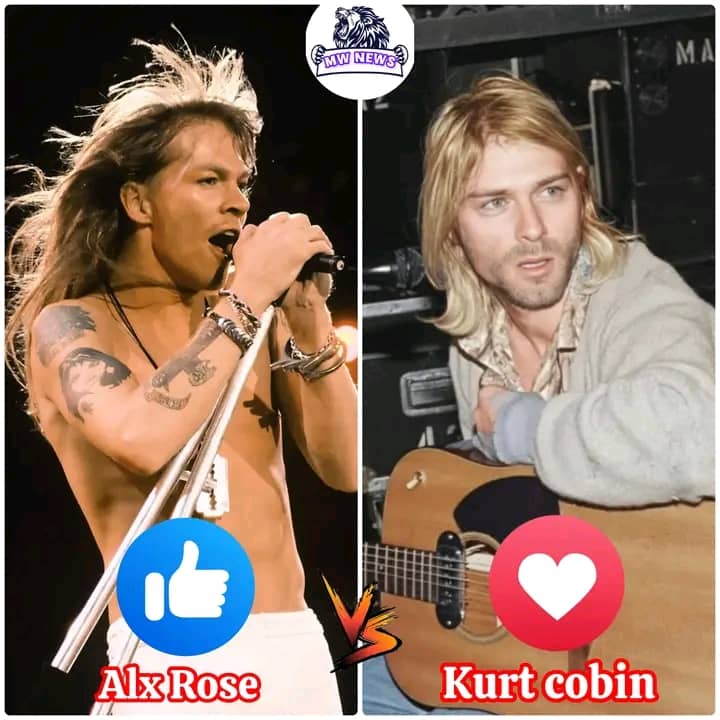
Rock history doesn’t move in straight lines. It explodes, fractures, and reinvents itself through personalities so powerful they reshape the sound, the culture, and the very idea of what a frontman is supposed to be. Few figures embody that truth more than Axl Rose and Kurt Cobain—two icons who didn’t just lead bands, but led movements that defined entire eras.
They were nothing alike.
And yet, rock music would not be what it is without either of them.
Axl Rose: The Ultimate Rock Frontman
Unpredictable. Explosive. Theatrical.
Axl Rose didn’t just walk onto a stage—he invaded it. From the moment Guns N’ Roses detonated onto the late-’80s scene, Axl felt less like a singer and more like a force of nature barely contained in leather pants and bandanas.
His voice alone rewrote the rulebook. It stretched from gutter-deep snarls to glass-shattering highs that few vocalists before or since have been able to touch. One moment he sounded feral, the next operatic. It wasn’t polished—it was dangerous. And that danger was the point.
But Axl’s power went far beyond vocal range.
He commanded stages with swagger and menace, stalking, pacing, spinning microphones like weapons. Every show felt like it could explode at any second—sometimes it did. Late starts, walk-offs, onstage rants… the chaos only fed the myth.
Guns N’ Roses didn’t become the biggest band in the world by accident. They became a phenomenon because Axl radiated intensity, attitude, and a complete refusal to be tamed. He embodied excess, ego, vulnerability, rage, and romance all at once.
With Appetite for Destruction, he gave rock its last truly dangerous mainstream album. With Use Your Illusion, he turned rock ’n’ roll energy into epic ambition. Love him or hate him, you couldn’t look away.
Axl Rose wasn’t trying to represent anyone.
He was trying to dominate.
Kurt Cobain: The Voice of a Generation
Raw. Emotional. Painfully honest.
Kurt Cobain was the anti-frontman—at least on the surface. Where Axl projected control and theatrical fury, Kurt looked uncomfortable with attention, uneasy with fame, and suspicious of power.
And that’s exactly why millions connected with him.
Kurt’s appeal wasn’t perfection. It was authenticity.
His voice cracked. His guitar screamed. His lyrics felt like diary entries ripped from someone who didn’t know how to ask for help. When Nirvana exploded with Nevermind, it wasn’t because the band chased stardom—it was because they tapped into something that had been silently building for years.
Anger. Sorrow. Disconnection. Rebellion.
Kurt sang like someone who didn’t care if you liked him—but desperately needed you to understand him. His fragile-yet-powerful voice turned vulnerability into a weapon. Songs like “Smells Like Teen Spirit,” “Lithium,” and “Come As You Are” didn’t sound triumphant. They sounded true.
He didn’t swagger across stages. He hunched. He thrashed. He looked like he might fall apart at any second—and sometimes did.
In doing so, Kurt Cobain became the reluctant spokesperson for a generation that didn’t trust rock gods anymore. The ’90s alternative era wasn’t about excess. It was about exposure.
And Kurt bled in public.
Two Frontmen, Two Philosophies
Axl Rose believed in spectacle.
Kurt Cobain believed in honesty.
Axl pushed rock to its most operatic, dramatic extremes—long songs, towering egos, emotional avalanches. Kurt stripped it back down to nerve endings, feedback, and emotional truth.
Axl wanted to be larger than life.
Kurt wanted to survive life.
Yet both men changed everything.
Axl closed the door on the classic rock era by turning it up until it nearly collapsed under its own weight. Kurt kicked down the door to the future, dragging punk ethics and emotional realism into the mainstream.
One ruled stadiums.
The other haunted them.
Why Both Are Legends—And Always Will Be
It’s tempting to pit them against each other. Fans have been doing it for decades. But the truth is simpler—and more powerful.
Rock needed both.
Without Axl Rose, rock might have lost its danger, its arrogance, its unapologetic hunger for dominance. He reminded the world that rock ’n’ roll could still be feral, excessive, and overwhelming.
Without Kurt Cobain, rock might have lost its soul. He proved that vulnerability wasn’t weakness—that honesty could be louder than volume and rebellion didn’t need leather pants to matter.
They represented two sides of the same scream.
One screamed outward.
One screamed inward.
The Legacy That Still Echoes
Today, you can hear Axl’s influence in every frontman who treats the stage like a battlefield. You can hear Kurt’s influence in every artist who dares to be imperfect, open, and emotionally raw.
They didn’t just front bands.
They defined eras.
Axl Rose turned rock stardom into legend.
Kurt Cobain turned pain into poetry.
Two frontmen.
Two revolutions.
One genre forever changed.
Leave a Reply