
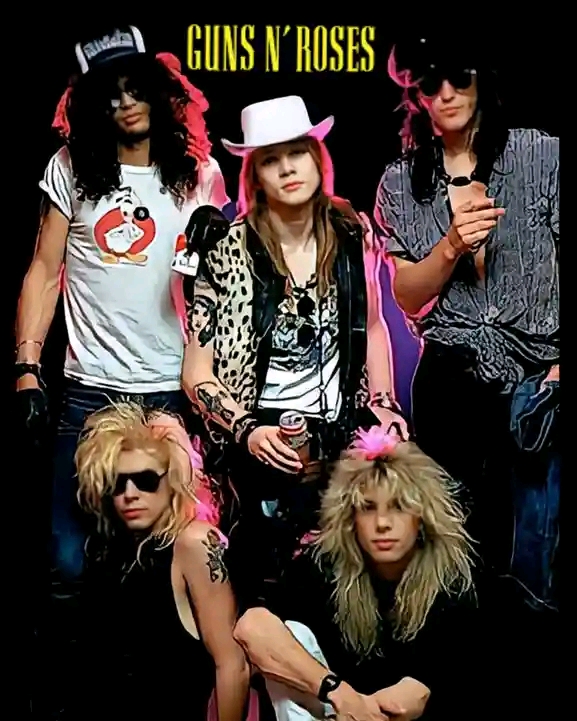
They didn’t just form a band. They ignited a riot that ripped through the polished excess of the late ’80s and dragged rock music back into the gutter—bloody, dangerous, and real. When people talk about Guns N’ Roses, they’re usually talking about this lineup: vocalist Axl Rose, lead guitarist Slash, rhythm guitarist Izzy Stradlin, bassist Duff McKagan, and drummer Steven Adler. Five men. One volatile chemistry. Zero rules.
For a brief, explosive moment in history, this was the most dangerous band on the planet.
The Birth of a Perfect Storm
Los Angeles in the mid-1980s was crawling with hair metal bands chasing fame with spandex and power ballads. Guns N’ Roses didn’t fit. They looked dirtier. They sounded angrier. And they carried themselves like they didn’t care whether you loved them or feared them—as long as you felt something.
The classic lineup came together almost by accident, but once it locked in, the result was electric. These weren’t session musicians or industry plants. They were street survivors, addicts, runaways, and dreamers who poured every scar into their music.
Axl Rose: The Volcanic Frontman
At the center stood Axl Rose, a frontman like no other. Beautiful, terrifying, fragile, and ferocious—sometimes all in the same song. His voice could shriek like a siren, snarl like a cornered animal, or soar with heartbreaking vulnerability.
But Axl wasn’t just a singer. He was the emotional engine of Guns N’ Roses. His perfectionism, paranoia, and raw intensity pushed the band to greatness—and drove everyone around him to the edge. Onstage, he was mesmerizing. Offstage, unpredictable. Missed shows, legendary tantrums, and internal battles became part of the band’s mythology.
Love him or hate him, Guns N’ Roses without Axl Rose would not exist.
Slash: The Guitar Hero Who Didn’t Look Like One
Then there was Slash—the top-hatted, cigarette-dangling guitar god who redefined what a rock guitarist could be. While others chased technical perfection, Slash played with feel. His solos weren’t exercises—they were conversations, screams, confessions.
The opening notes of “Sweet Child O’ Mine,” the snake-like menace of “Welcome to the Jungle,” the raw blues of “Paradise City”—those riffs became cultural landmarks. Slash didn’t need flashy tricks. He needed six strings, a Les Paul, and something to prove.
His chemistry with Axl was combustible. Together, they created magic. Separately, they nearly tore the band apart.
Izzy Stradlin: The Quiet Architect
Often overlooked, Izzy Stradlin was the backbone of the classic lineup. While Axl and Slash grabbed headlines, Izzy wrote riffs, structured songs, and kept Guns N’ Roses grounded in groove and grit.
Izzy’s rhythm guitar work gave the band its swagger. He understood restraint—when to step back, when to drive the song forward. Tracks like “Mr. Brownstone” and “Patience” don’t work without Izzy’s subtle brilliance.
When he eventually walked away, exhausted by chaos and addiction, many fans believe the soul of the original Guns N’ Roses left with him.
Duff McKagan: Punk Attitude Meets Metal Muscle
Duff McKagan wasn’t just a bassist—he was the glue. Raised on punk rock, Duff brought speed, attitude, and intelligence to a band drowning in excess. His bass lines were aggressive yet melodic, anchoring the madness with precision.
Beyond the music, Duff often acted as the bridge between clashing egos. While others spiraled, he observed, learned, and survived. His later recovery and reflections have made him one of the most respected voices from that era.
Without Duff, Guns N’ Roses might have collapsed even sooner.
Steven Adler: The Heartbeat That Couldn’t Keep Time With Addiction
On drums sat Steven Adler, whose loose, swinging style gave early Guns N’ Roses its unmistakable groove. His playing wasn’t mechanical—it breathed. Songs like “Rocket Queen” and “My Michelle” live and die by Adler’s feel.
But addiction swallowed him whole. As the band skyrocketed, Steven struggled to keep up. Missed sessions, declining reliability, and worsening substance abuse eventually led to his dismissal—a decision that still haunts fans.
Many believe that when Adler left, Guns N’ Roses lost its original heartbeat.
Appetite for Destruction: The Album That Changed Everything
Released in 1987, Appetite for Destruction didn’t just succeed—it detonated. Fueled by the classic lineup’s chemistry, it became one of the best-selling debut albums in history.
These songs weren’t fantasies. They were lived experiences—violence, lust, desperation, ambition. The band wasn’t pretending to be dangerous. They were dangerous.
And the world couldn’t look away.
Fame, Fracture, and Fallout
Success magnified every crack. Egos grew. Substance abuse intensified. Control battles erupted. The same chaos that made the classic lineup so powerful eventually tore it apart.
By the early ’90s, the dream was unraveling. Adler was gone. Izzy followed. Slash and Duff eventually walked away. Axl remained, guarding the Guns N’ Roses name like a fortress.
The classic lineup became legend—frozen in time.
Why the Classic Lineup Still Matters
Decades later, fans still speak of Axl, Slash, Izzy, Duff, and Adler with reverence. Not because they were perfect—but because they were real. Flawed. Dangerous. Unrepeatable.
They reminded the world that rock music wasn’t meant to be safe.
For a few blazing years, Guns N’ Roses weren’t just a band. They were a warning shot.
And nothing that came after ever quite matched the sound of that explosion.
Leave a Reply