One by one, Guns N’ Roses trickled back to LA, where it was Slash’s turn to lose the plot. The period would see him shooting speedballs, blowing a….

One by one, Guns N’ Roses trickled back to LA, where it was Slash’s turn to lose the plot. The period would see him shooting speedballs, blowing a hole in his roof with a .44 Magnum, spraying Izzy’s bathroom with arterial blood during a clumsy tie-off and – most spectacularly – running naked and sobbing around an Arizona golf course, hallucinating that he was being chased by the monster from Predator.
It’s an episode we gloss over today. However, the fact remained: something had to give. Ultimately, after a hellish withdrawal period, Slash returned from the brink. Then a string of jams at the Mates rehearsal space confirmed that even without chemicals, GN’R had chemistry.
“How was I doing personally?” ponders Slash of the moment when Illusion started to pull together. “Well, by then, I was off smack, so that was good. That was like the motivator for me. So I was having a good time just doing my regular heavy drinking, as normal.”
How about the band as a whole? “We reconvened. I think the Guns N’ Roses chemistry was a natural thing that was always there if we could just get past other distractions. When we dropped all the bullshit and just started playing, there was a natural synergy between us.
“It was a positive time. We started going out, playing shows, opening for the [Rolling] Stones. We’d gone from fourth on the bill at Donington and all of a sudden we’re headlining stadiums.”
“I remember thinking my playing had gotten to a point on those Illusion records where I was really happy.” Slash
In the end, it was a marathon two-night writing session at Slash’s house that broke the back of Illusion, turning the screws on countless half-finished doodles, including pivotal moments such as The Garden, Duff’s ferocious Get In The Ring and So Fine, plus a number of songs by the underrated Stradlin.
“I always thought Izzy’s Double Talkin’ Jive had a cool vibe,” reflects Slash of the sneering track about a dismembered body found in a dumpster behind the studio. “And I got to play that little Spanish flamenco part on it.” For the first time since ’86, it was all so easy.
“It had just been so difficult to get into that groove,” reflects Slash. “Finally, Axl, Duff, myself and Izzy had that acoustic session and basically sewed it up.”
There was also a sense of closet-cleaning about the Illusion records. Many of the albums’ songs had histories that stretched back years: Dead Horse was an old Axl tune, Back Off Bitch predated Gun N’ Roses’ formation, You Could Be Mine was just a whammy solo away from the version bumped from Appetite, while the long-incubated November Rain had the same soaring solo as its 1986 incarnation.
“Right from its inception,” recalls Slash, “when Axl and I first played November Rain, the same guitar melodies that are in the recorded version came through. There was definitely a spark between the two of us.
“It was hard to arrange that song and Estranged, because they were so open-ended and we had to cut November Rain. But those were Axl’s epic piano pieces and they were both breakthrough guitar solos for me. Real melody solos, y’know? I had some good sounds and they were melodically very spontaneous.”
Before the difficult Chicago sessions, a messy month spent house-sharing with Izzy had yielded Locomotive, plus the song that arguably stands out as the most ambitious guitar moment on either of the Use Your Illusion records.
“I wrote Coma in my heroin delirium,” admits Slash of the 10-minute-long opus. “That’s a song that I’m still proud of. There’s not a lot of ‘technique’ – it’s a pretty straight up kinda Slash approach.
“But the thing that’s really interesting was the vamp-out, which was this circular rotating chord progression that never ended: the same chord progression every time, but it just kept changing key. That was my mathematical musical discovery. I just stumbled on it and it’s very much me doing my thing… but it worked.”
Did Slash try to put his technique under the microscope for Illusion? “I don’t know if I had a particular aim with my style,” the guitarist considers, “but I do remember thinking my playing had gotten to a point on those Illusion records where I was really happy. I’m not what you’d call a ‘technique guy’.
“I’ve always taken it seriously when I’m actually doing it, but I just go for it: I don’t spend a lot of time thinking about that stuff. I don’t go, ‘Oh, I held my finger this way on the pick and this happened’, or ‘I stood 14 inches to the left of my cabinet to get this sound’. I mean, I do shit like that… but I don’t know what I’m doing!”
[Civil War] was the first song where we went in the studio with Steven and realised that he wasn’t really playing up to par
Still, it worked, both on the ambitious Coma and the play-in-a-day arpeggios that kick off Civil War. “That was actually one of the first songs Axl and I wrote after Appetite,” Slash explains. “The tour wasn’t even finished, Axl heard me playing this acoustic thing and we started rehearsing it with the band in Australia. It was also the first song where we went in the studio with Steven and realised that he wasn’t really playing up to par.”
Ah yes – Steven Adler. A childhood friend of Slash’s, the drummer had taken a similar slide into junkiedom, but with the crucial difference that he could neither kick the habit nor maintain his chops while under the influence. Civil War, a tempo-shifting number with a double-time crescendo, was the final nail in his coffin.
“I did the demo tapes for Use Your Illusion,” Adler told this writer in an interview with Classic Rock. “We’d go in, play the songs, go to the listening booth and say together, ‘This is gonna be bigger than fuckin’ Appetite’. And it would have been. But because of my fuck up, we didn’t finish what we started.”
With Matt Sorum bumping Adler from the drumstool, GN’R’s last-gang-in-town image had its first hairline crack, but as a functioning band they were ready. The five men headed into A&M with producer Mike Clink to lay the foundations of the twin albums.
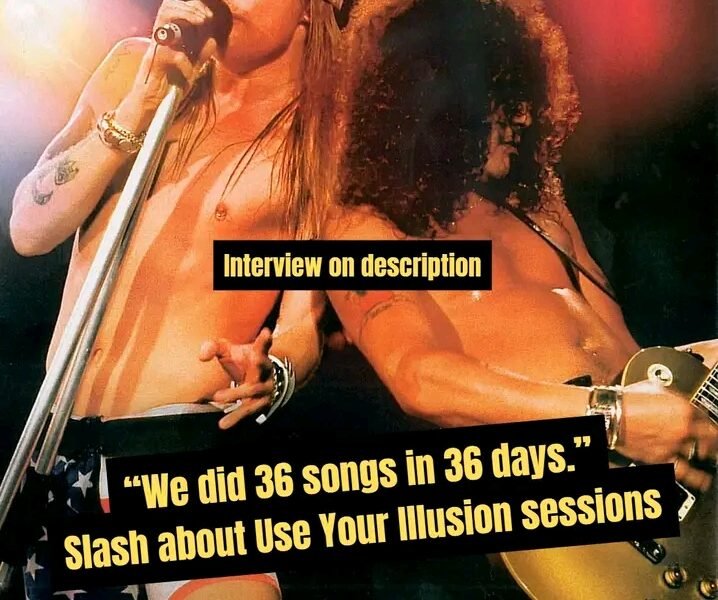
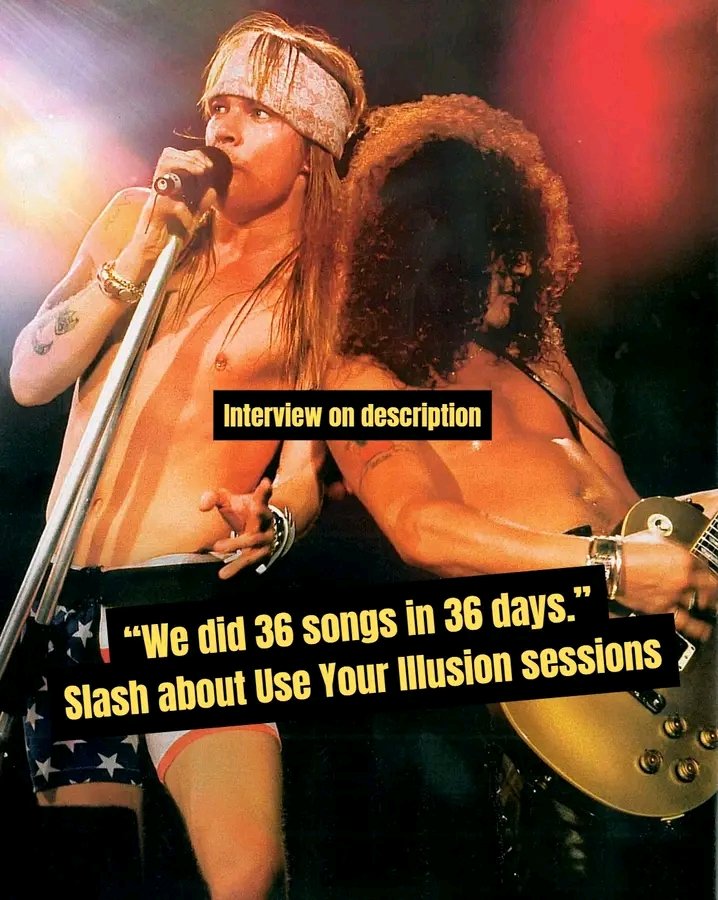
“It was fucking great,” grins Slash. “I’d already spent time in pre-production on all that stuff, where we’d sorta play the song from one end to the other, so when we went in, I basically knew it. When I’m in the studio, I don’t want to fuck around. I want to move on. I don’t dwell on it too much. Before you know it, we were doing th
e basic tracks. We did 36 songs in 36 days.”