
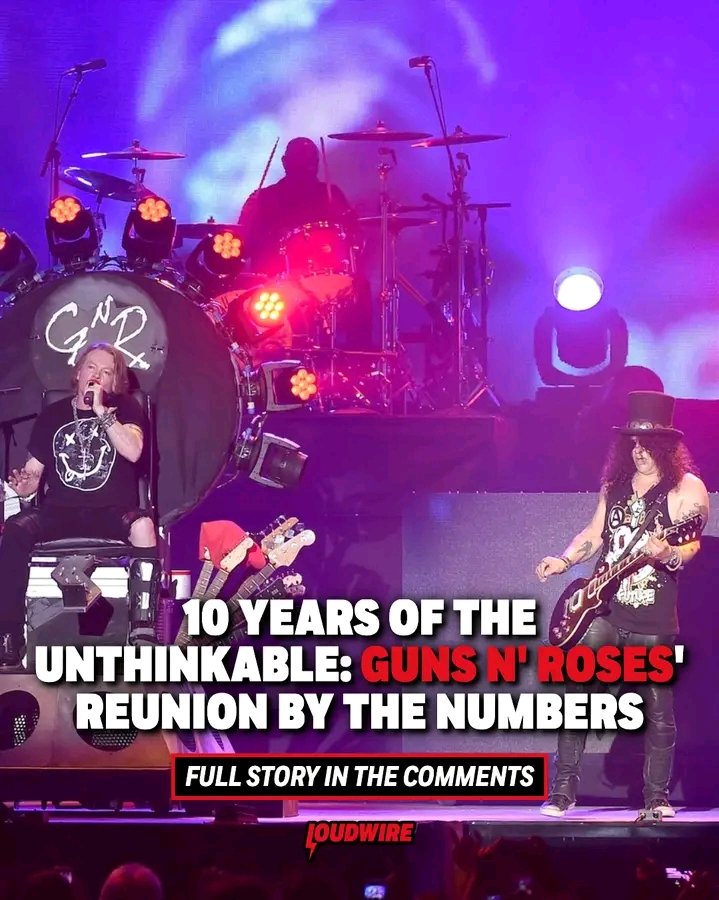
Ten Years After Guns N’ Roses’ Historic Reunion, the Impossible Comeback Finally Makes Sense And the Numbers Are Absolutely Insane
For decades, even the most loyal Guns N’ Roses fans rolled their eyes at the rumors. Every year, whispers of a “classic lineup reunion” resurfaced, only to be crushed again by interviews, lawsuits, bad blood, and the band’s brutal honesty: it’s never happening. Not maybe. Not someday.
Never.
Axl said it. Slash implied it. Duff dodged it. Insiders dismissed it.
And fans heartbroken but realistic believed it.
Until the night they were all proven spectacularly, gloriously wrong.
Now, ten years to the day since Guns N’ Roses detonated the music world with the launch of their massive “Not in This Lifetime…” reunion, we’re breaking down the once-unthinkable feat by the numbers. The scale is ridiculous. The chaos is legendary. And the impact is far bigger than anyone including the band ever imagined.
Let’s get into it.
10 YEARS OF A MIRACLE: THE NUMBERS BEHIND GN’R’S IMPOSSIBLE REUNION
The Tour Name Was a Joke Until It Became Prophecy
When GN’R officially announced the reunion with a smirking tour title, “Not in This Lifetime…,” fans laughed.
It felt like Axl winking at years of denial, conflict, and broken relationships.
But no one knew the joke would turn into the highest-grossing rock reunion of the modern era.
And it all started with one night, one stage, and one image that broke the internet:
Axl. Slash. Duff. Together again.
That single moment rewired rock history.
SHOWS PLAYED: 175 AND COUNTING
When the reunion launched, most people expected a few U.S. dates, maybe a short world run if everyone survived the first leg.
Instead?
Guns N’ Roses played more than 175 shows across the globe, from the U.S. to Europe, Asia, Latin America, Australia, the Middle East, and everywhere in between.
From sold-out arenas to packed stadiums to historic festival headlining slots, the band turned a reunion that wasn’t supposed to exist into a marathon victory lap.
Every continent.
Every crowd size.
Every generation showing up at once.
This wasn’t nostalgia it was domination.
DOLLARS GROSSED: OVER $580 MILLION
Let’s be blunt: Guns N’ Roses didn’t just get back together.
They printed money.
With more than $580 million grossed, the “Not in This Lifetime…” tour became:
The third highest-grossing tour in music history at the time
The highest-grossing rock reunion tour ever recorded
A financial juggernaut that stunned the industry
And here’s the crazy part:
They didn’t even release a new album first.
The demand alone was enough to fill stadiums worldwide for nearly three straight years.
SONGS RELEASED: A TRICKLE THAT CHANGED EVERYTHING
Before 2016, the idea of Slash and Duff recording new music with GN’R again seemed as impossible as the reunion itself.
And yet, slowly, unexpectedly, it happened.
First came revamped versions of long-lost tracks like “Shadow of Your Love,” which exploded online.
Then came reworked Chinese Democracy-era songs like “Hard Skool” and “Absurd,” the first new material featuring Slash and Duff in decades.
Then came the real shocker:
the band actually entered the studio together.
While GN’R didn’t drop a full album during the reunion’s first decade, they released enough material to prove something important:
This wasn’t just a tour.
It was a resurrection.
FEET BROKEN: (BUT LEGENDARY)
No recap of the GN’R reunion is complete without the most ironically rock-and-roll injury in reunion history.
Axl Rose broke his foot before the tour even officially launched.
Not during some dangerous stage stunt.
Not in a pyrotechnics mishap.
Not during a wild night out.
No the man shattered his foot during rehearsals.
Most artists would postpone.
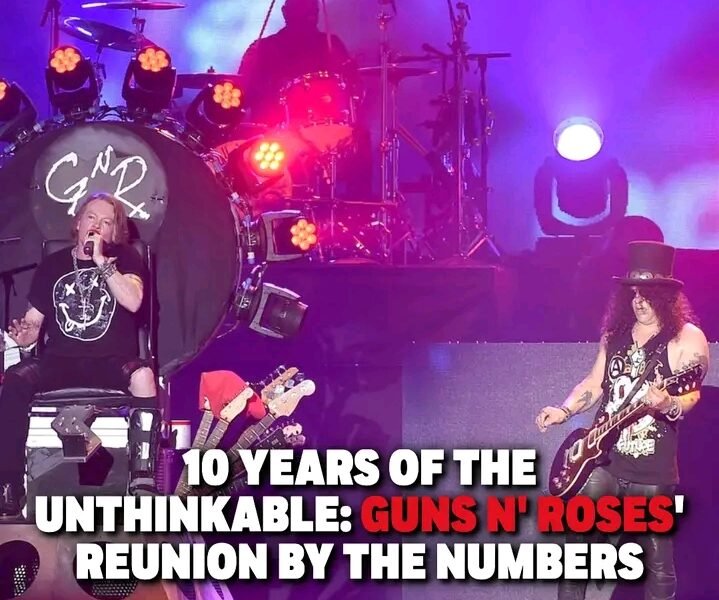
Axl? He performed the first shows of the reunion in a throne borrowed from Dave Grohl.
It became an instant meme, a symbol of resilience, and a strangely beautiful start to a reunion everyone thought was impossible.
Broken bones, unbroken momentum.
CREWS EMPLOYED: 200 WORLDWIDE
A reunion of this scale didn’t just revive a band it revived a small industry.
The GN’R machine employed:
Stage techs
Audio engineers
Security teams
Road crew
Tour managers
Lighting designers
Pyro experts
Medical staff
Production coordinators
Transportation teams
Local event crews
Stadium staff
At peak capacity, more than 200 people worldwide were employed to make the reunion function night after night.
This wasn’t just a tour.
It was a global operation.
CITIES SHUT DOWN: TOO MANY TO COUNT
From traffic-clogged streets to overwhelmed airports to hotels packed with fans from multiple continents, GN’R didn’t just visit cities they took them over.
ICONIC MOMENTS INCLUDED:
Mexico City nearly collapsing under demand
São Paulo breaking attendance records
Tokyo fans lining up 24 hours early
Los Angeles turning the Forum into a three-night madhouse
Buenos Aires roaring so loudly that fans compared the sound to a jet engine
You don’t get those reactions without cultural impact.
Major impact.
THE IMPOSSIBLE FRIENDSHIP THAT SAVED ROCK
The reunion didn’t just give fans history it gave us healing.
Watching Axl and Slash stand shoulder-to-shoulder again was something no one believed would ever happen.
Not even insiders.
Ten years later, their partnership feels stronger than ever.
The respect is visible.
The chemistry is real.
The fire is still there.
And honestly?
That’s the biggest number of them all:
The reunion’s impact will last forever.
TEN YEARS LATER, THE VERDICT IS SIMPLE
They swore it would never happen.
We believed them.
We had every reason to.
But when the impossible reunion finally arrived, it wasn’t just successful it became one of the most legendary comebacks in rock history.
The numbers prove it.
The shows proved it.
The fans proved it.
And ten years later, the truth is undeniable:
Guns N’ Roses didn’t just reunite.
They rewrote the rulebook